

Tennessee has fewest distressed counties in state history
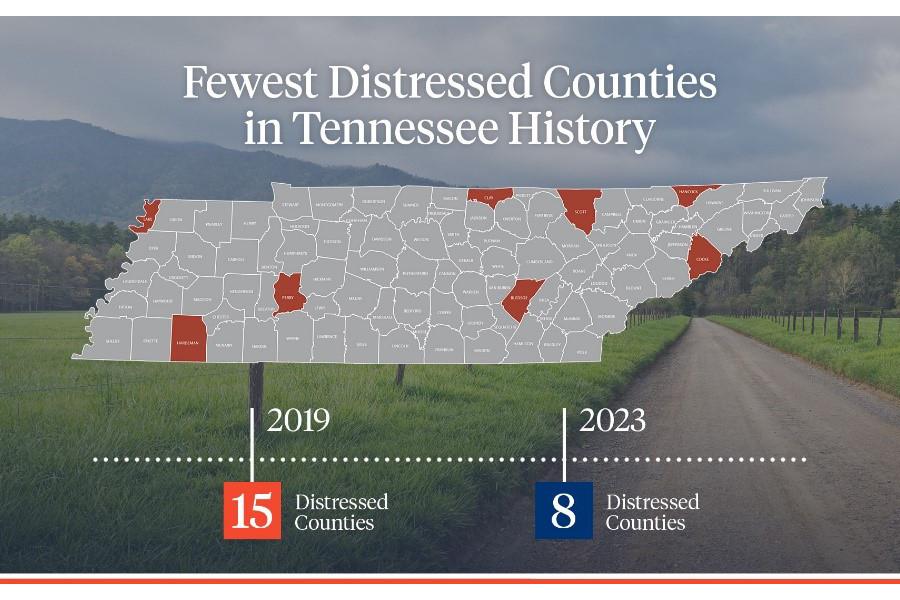
Tennessee Gov. Bill Lee announced that the number of distressed counties in the state has reduced to eight, the fewest in Tennessee history, marking a significant milestone in the Lee administration’s mission to accelerate the transformation of rural Tennessee.
“In 2019, we began an administration-wide mission to expand opportunity for Tennesseans in rural areas, and our strategic workforce and infrastructure investments have resulted in an historic reduction of our state’s distressed counties,” said Gov. Lee. “What happens in rural Tennessee matters to all of Tennessee. As Tennessee experiences unprecedented economic growth and job creation, we’ll continue our work to prioritize rural communities so that Tennesseans in every county can thrive.”
According to the Appalachian Regional Commission (ARC), Grundy and Morgan counties advanced out of the distressed designation this year, reducing the total number of distressed counties(opens in a new tab) from 15 to eight since 2019.
Since taking office, Gov. Lee has prioritized significant workforce, education and infrastructure investments to ensure economic growth, job creation and a greater quality of life across rural Tennessee. With these investments, the Governor has secured 213 economic development projects in rural counties that have netted more than $16 billion in capital investment and 33,000 new job commitments since 2019.
Notable strategic investments to support rural Tennessee’s success since 2019 include:
Executive Order 1
- Directing all state departments to issue a statement of rural impact and examine how they are serving rural areas in Tennessee, specifically distressed counties, through Executive Order 1(opens in a new tab)
- Requiring departments to provide recommendations for improvements on how to best serve rural communities in a variety of areas, including workforce development, business recruitment, critical infrastructure, education and more
Workforce Development
- Prioritizing career and technical education in distressed and at-risk counties through the Governor’s Investment in Vocational Education(opens in a new tab) (GIVE) Act, which expanded access to work-based learning, apprenticeship programs and dual enrollment courses for trade and technical programs
- More than $200 million to improve and expand Tennessee Colleges of Applied Technology (TCAT) infrastructure across our state, in addition to more than $98 million for the TCAT Enrollment Initiative since 2021 to help reduce waitlist times for students to participate in vocational education programs
K-12 Education
- $500 million to expand middle and high school career and technical education programs across the state
- Extending additional dual enrollment credits for high school juniors and seniors through the Governor’s Investment in Education (GIVE) program
- More than $1 billion in new, recurring funds to reform the state’s 30-year-old funding formula through the Tennessee Investment in Student Achievement(opens in a new tab) (TISA) Act, an innovative education model that funds each Tennessee student based on individual needs, paying particular attention to rural students
- Creating the Future Workforce Initiative(opens in a new tab) to increase STEM training in K-12 schools, aimed at placing Tennessee in the top 25 states for creating technology jobs by launching new Computer Science and STEM-focused programs
Modernizing Infrastructure
- $447 million to provide broadband access(opens in a new tab) to more than 150,000 unserved homes and businesses across 58 Tennessee counties
- $1.3 billion for water and sewer development(opens in a new tab), approved by Tennessee’s Financial Stimulus Accountability Group
This year, Gov. Lee prioritized additional investments that will continue to prepare rural Tennessee for long-term growth and success, including:
Continued Investments in Rural Tennessee
- A $3.3 billion investment to implement the Transportation Modernization Act(opens in a new tab), Tennessee’s new transportation and infrastructure strategy to widen rural interstates and alleviate urban congestion, including $300 million for local highways across Tennessee – without raising taxes or going into debt
- $1 billion to complete the TCAT Master Plan(opens in a new tab) to improve 16 existing TCATs, replace seven outdated facilities and build six new TCATs at strategic locations across Tennessee
- More than $400 million in tax cuts for Tennessee families and businesses through the Tennessee Works Tax Act(opens in a new tab), one of the largest tax relief measures in Tennessee history
- The Rural Brownfields Investment Act(opens in a new tab) to begin remediation efforts for 175 known brownfield sites, including the creation of a new state-administered grant and technical support program for remediation and economic development of existing brownfields
- $50 million Nuclear Fund and creating the Tennessee Nuclear Energy Advisory Council(opens in a new tab) to recruit companies to our state that will establish a nuclear development and manufacturing ecosystem built for the future of Tennessee
- $350 million in additional funding to local education agencies through the TISA and an historic pay raise for teachers(opens in a new tab), making Tennessee a top-10 state for teacher pay
“Elevating rural Tennessee is one of our top priorities, and by providing a pro-business climate for Tennessee companies to succeed, they are in turn providing high-quality job opportunities for citizens across the state,” said Tennessee Department of Economic and Community Development Commissioner Stuart McWhorter. “While today’s announcement is proof that we have made significant strides in reducing the number of distressed counties in Tennessee, we are committed to the eight remaining counties to help improve their economic status designations in the years ahead.”
Each year since 2007, the ARC has compiled an index of county economic status for every county in the United States. Economic status designations are identified through a composite measure of each county’s three-year average unemployment rate, per capita market income, and poverty rate. Based on these indicators, each county is then categorized as distressed, at-risk, transition, competitive or attainment. Learn more from the Appalachian Regional Commission website(opens in a new tab).