
Chattanooga's National Park City designation 'just the beginning'
By KATE COIL
TT&C Assistant Editor

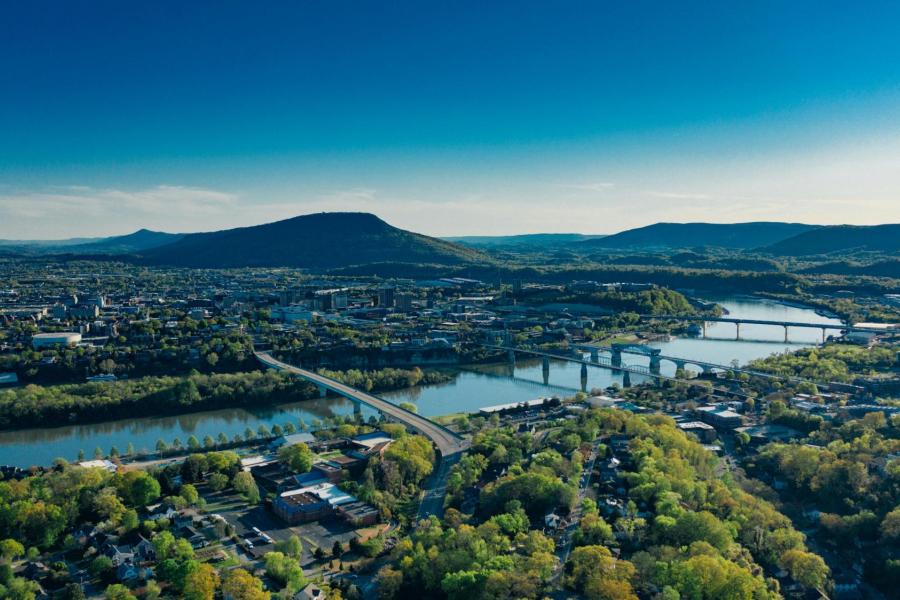
Natural beauty, outdoor activities, and a commitment to conservation are among the reasons the city of Chattanooga was chosen as the first National Park City not just in the U.S. but in the whole of the western hemisphere.
The National Park City Foundation(opens in a new tab) was created by British National Geographic explorer Daniel Raven-Ellison to encourage cities to promote their outdoor community assets as national parks do. Chattanooga is only the third city in the world to obtain the designation, behind London, U.K., and Adelaide, Australia.
Alison Barnes, Trustee of the National Park City Foundation, was one of the officials who visited Chattanooga during the process.
“During our peer review we saw first-hand the extraordinary breadth and depth of engagement with the Chattanooga National Park City vision informed by outstanding experts in design, ecology, culture and arts,” Barnes said. “National Park City status introduces a new chapter for a city with a long history of revitalization and renewal through connecting its unique landscape and the history of its people.”

Brian Smith, communications and marketing director with Chattanooga Parks and Outdoors, was one of the key figures who helped turn the idea of Chattanooga as a National Park City from dream to reality. He said the city's former City Administrator Scott Martin was a member of World Urban Parks – one of the organizations that helps evaluate candidate cities – along with Raven-Ellison when the National Park City concept began.
“We are encouraging people to think of Chattanooga as a city in a park instead of just a city with a bunch of little parks in it,” Smith said. “That doesn’t mean we have to put a park everywhere. It means I can enjoy the park down the street, but I can also enjoy where I’m from by adding some things to my own backyard. We don’t have the most parks of any city, but it’s the availability of parks we have. The uniqueness of those parks makes us a city in a park.”
One of the initiative's goals is to show the diversity of species, outdoor activities, and opportunities in urban settings. The National Park City Foundation was also looking for a city of Chattanooga’s size to participate in the program.

“Chattanooga's competitive advantage is the outdoors, the recreation, and the amenities we have around the city,” Smith said. “We also have a story of a city with a tumultuous past. We were the starting point of the Trail of Tears, endured the Civil War, and were ranked the dirtiest mid-sized city in the 1970s. Now, we are world-recognized for our green efforts.”
To qualify, Chattanooga had to meet 23 criteria, including showing policies the city was considering, proof of government and citizen support, and a charter outlining future goals. As goals are met, the committees set new targets, and at the end of 2026, the city will produce an annual report on the progress it has made as a National Park City. The role of the city is to keep committees on track.
“We set up charter teams to spearhead each goal,” Smith said. “For example, one of our goals was having unrivaled access to nature, meaning the committee would have to address what barriers we had to access to nature and how to eliminate them. We also have a committee for sustainable growth as people continue to move here."
Another part of the criteria was producing a “journey book” showing the history of Chattanooga and its work toward earning the National Park City title. Bringing in Chattanooga’s reputation as a Gig City, partners created a digital journey book(opens in a new tab) rather than a physical one with plans to update the online version as goals are achieved.

“Our journey book does not have a ‘the end’ because we know we are going to keep adding to it,” Smith said. “That is where technology and the design element came in. Also, everyone has a phone and devices. If we can make access to this information more available on their phones, that will get more people out and about. We are hoping this can show people how to access things they are interested in and what organization is supporting that. We figure if everyone has devices in their hand, let’s utilize that to get more information to the people.”
One of the final steps in the process was a site visit from international representatives on behalf of the foundation. Smith said the group spent three days being shown as many of the projects and people working toward the designation as possible.
“They wanted to come here and see what they had read about in our journey book,” Smith said. “Part of it was to see if we were doing what we had, but they also wanted to meet the people we had talked about, understand our plans, and see the work we had done. We showed them that you can stay downtown and literally go bouldering or kayaking or biking on the greenway from there.”
The group toured the Tennessee Aquarium and the Tennessee Aquarium Institute to learn about aquatic conservation efforts, the Chattanooga Zoo and its Hellbender Research Area, as well as public art, city initiatives, parks and preserves, and natural areas.

“For me, who has lived here 15 years, it reassured me how special Chattanooga is,” Smith said. “We are not perfect, but we really have a lot of special things here. What we have been able to overcome over the years and the people who have put that together are amazing. On one side of town, we’re saving red wolves and on the other we are growing fish to put back in the river.”
Smith said the National Park City recognition is just beginning of the city’s journey with the designation helping to hold the city accountable for moving forward with commitments made during the process. One goal is to better promote showcasing the various ways the city and partner organizations are doing around the city to improve water quality, nature access, and outdoor activities.
The initiative is changing how Chattanooga thinks about and promotes itself as an outdoors destination. Smith said a lot of the process began by asking people to ask “what if Chattanooga did this” or “what if Chattanooga had that?” When the response came in, Smith said he and many city officials realized some of these proposed opportunities already existed within the city and just weren’t being promoted enough.

The city is currently working on a list of 100 mini-adventures – most free activities – citizens and visitors can take place in to promote the National Park City spirit.
“Everybody can participate and do something to be part of a National Park City,” Smith said. “You don’t have to come to meetings or be part of a committee team or volunteer. If you plant more native grasses or flowers, that is contributing to a National Park City. If you bike or walk or kayak down the river, that is part of being a National Park City. If you enjoy public art, that is a part of it. It is the responsible of the city and our partners to provide as much access to those things as possible so people can take advantage of that.”
Going forward, Smith said the city is looking for ways to fill gaps in who in the community is served and turn the National Park City website into a hub for information local opportunities and programs.