

Bartlett reinvisions 60-year-old park with inclusive playground, data-driven approach
By KATE COIL
TT&C Assistant Editor
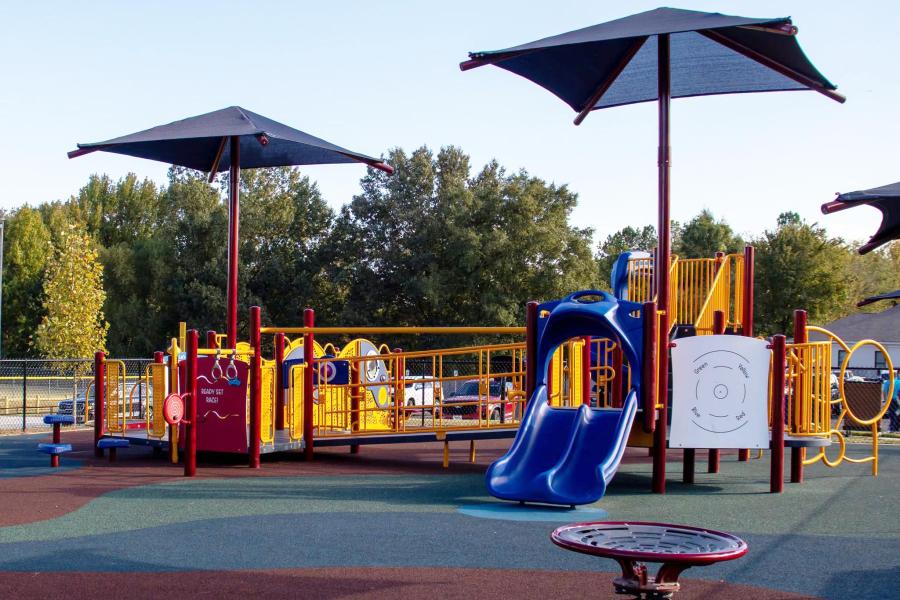
Renovations to a 60–year-old park in Bartlett include a new, fully-inclusive playground with a data-driven approach to recreation.
The new playground at Shadowlawn Park is the cornerstone of a $1.5 million dollar renovation that also includes resurfaced pickleball courts, a new restroom, new concession facilities, accessible walkways, and 50 new parking spaces.
Bartlett Parks and Recreation Director Paul Wright said the city had been looking for a place to build a new inclusive playground for all users, regardless of their sensory, mobility, and cognitive challenges.

“We did not have an inclusive play space available,” Wright said. “All of our playgrounds are accessible, but none were inclusive. A lot of people intermix those terms, but they really don't mean the same thing. An accessible playground – which we are all required to do by legislation – just means you have to be able to get to the play structures, not necessarily use every single piece of equipment there. Someone with a mobility aid may have some parts of the equipment they can use, but the entirety of the playspace is not available to them. A fully inclusive playspace is designed with the intent that everybody, regardless of ability, is allowed to play alongside and together with each other.”
Shadowlawn Park was picked as an ideal location for this new playground. Originally opened in the mid-1960s by the Shelby County Conservation Board, the 17.2-acre park had a restroom facility added in 1971 and then a baseball diamond and basketball court. In 2005, the park was deeded over to the city of Bartlett.
“One of the challenges all municipalities obviously face is the limited resources of time, money, and manpower. We had developed our strategic master plan for our parks and recreation system in 2024 to help guide what we needed to do to direct those resources most effectively.
Working with citizens, officials, staff, and focus groups, Bartlett created a strategic master plan that then allowed the city to apply for various grants and resources. Shadlowlawn Park was one of the key areas of focus in the plan, and the city earned a state Local Parks and Recreation Fund(opens in a new tab) grant with the initial aim of making pathways and restrooms at Shadowlawn ADA accessible. However, bids for that project came back $500,000 above the city’s budget for the project.

“We knew this was something we wanted to do and needed to do, but we didn’t have the funding. Our – then new at the time – Mayor David Parsons started talking with us about the project and if there were ways we could look at things differently, such as redesigning the restroom, and spread cost across different areas. The playground there previously was built in 1999, and you don’t really want to have a playground older than 20 years from a safety standpoint and to meet community needs.”
With the expansion of Little League at the park and the pickleball courts added to Shadowlawn in 2021, new parking was also needed. Going back to the drawing board, Wright said the city redesigned the project, broke it up into phases, and obtained more grant money, allowing for $1.5 million to be spent on the overall project. As part of this phased approach, the city decided not to do a sealed bid process for the playground but instead issued a request for proposals (RFP) with a specific scope, list of features, and options for creativity.
Goals for the playground included having areas for different age groups, multi-sensory experiences, equipment that could serve children of all abilities, social playzones for interaction, and retreat spaces. From nine respondents, Wright said four staff members narrowed it down to Cunningham Recreation, one of the participants in the National Demonstration Site(opens in a new tab) program by Chattanooga-based PlayCore.
Wright said he and members of the department had attended a Tennessee Recreation and Parks Association (TRPA) workshop PlayCore held on the National Demonstration Site program, which recognizes parks, playgrounds, fitness areas, and trails for evidence-based design practices through PlayCore’s Center for Outreach, Research, and Education(opens in a new tab) (CORE) program.
“We saw that workshop when we were going through the master plan and this project was already at the forefront of our thoughts,” Wright said. “When we saw that workshop at the TRPA conference, it piqued our attention. We thought it would be so cool to have one of those playgrounds in our system, and Shadowlawn would be a great place to put one at. We didn’t specify that we wanted a National Demonstration Site in the RFP, but we knew Cunningham could bring that to the table.”
The Bartlett playground is part of the inclusive play and physical activity site models established by PlayCore, which uses data to guide design. Wright said working with PlayCore gave the city access to experts in the field who could help determine the best features for their community.
“One of the aspects of a National Demonstration Site is that it does tie into established research and best practices in terms of how equipment is laid out and what types of equipment is chosen,” Wright said. “It incorporates research-drivenbest practices. Knowing that there is already research backing the way this playground has been designed, it does literally put us on a map that we have a playground that meets these. We are one of only 16 playgrounds in Tennessee with multiple designations and one of only four in West Tennessee.”
As part of the program, visitors can scan QR codes at the Shadowlawn playground to give feedback that guides Bartlett and PlayCore in future playground design, implementation, and inclusion.

“That provides an opportunity for visitors to give specific feedback about this site, what they liked, and what they didn’t like,” Wright said. “That gets aggregated into a data portal that we and PlayCore have access to. The CORE research team uses that data, and we can use that data to see how this playground is impacting our community and what health outcomes we are seeing for families. From a parks perspective, it allows us to advocate for additional funding for similar sites in our park system.”
Wright said the feedback on Shadowlawn Park and its new playground has shown there is room for similar facilities in the city and will continue to inform decision-making going forward.
“This playground is in our eastern section of our city limits, so we are definitely targeting something toward the west side for our next inclusive playspace,” he said. “We have 21 total playgrounds within our park system and 13 to 14 of them are in the 20-year bracket needing replacement. We are making decisions on updating and revising those.”
For families of children with special needs, the map feature also allows them to see where and what type of recreation facilities can accommodate them. These facilities not only provide children with the opportunity to be active regardless of their ability ,but also a vital chance to socialize with other children and families.
“You cannot discount the benefits that are achieved by being engaged together with other members of the community, people who are similar to you versus the way many people with disabilities have been traditionally isolated,” Wright said. “Seeing all of those family members, caregivers, parents, and kids together, and the laughter and smiles we saw are priceless.”
One example of this was a recent Halloween event held for the special needs community at Shadowlawn. Wright said approximately 250 people participated, many coming well before it began and others staying until well after it was over so they could engage with each other.
“We had our first Special Needs Trunk or Treat at Shadowlawn Park,” Wright said. “We had about 20 to 25 trunks set up for special needs families and had a chance to hear directly from these families about how important this event and the playspace are to get their children outside. To see all of those families engaging together on that playspace was proof that we are doing the right thing. You could see the actual impact in person, experience it, and get that feedback and that made it all worthwhile.”