

WET Center aims to innovate resilient infrastructure solutions
By KATE COIL
TT&C Assistant Editor
A new state-run facility aims to give public works, city planning, emergency services, and municipal leaders a better understanding of how water can impact public infrastructure and public safety.

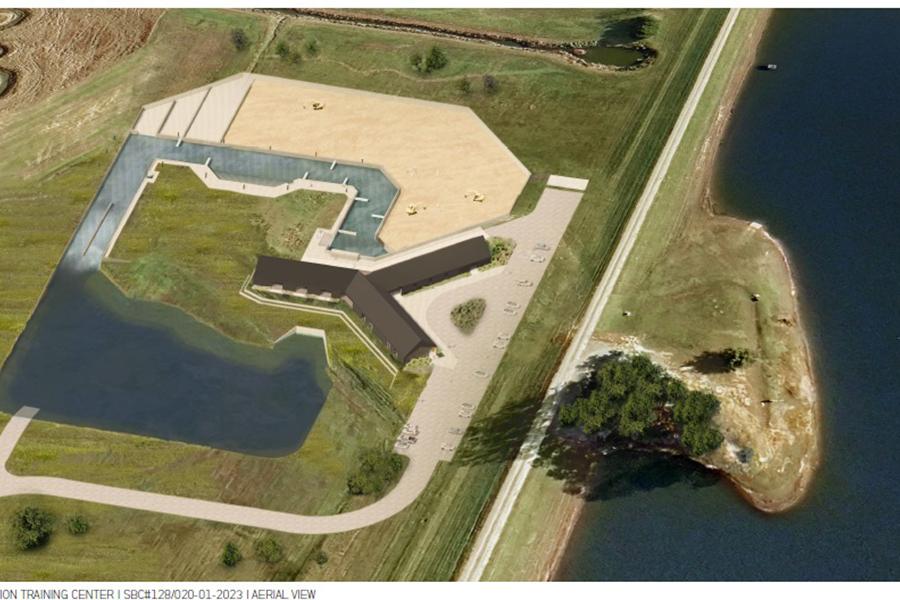
The Water Education and Training (WET) Center(opens in a new tab) is located between Bolivar and Middleton at the University of Tennessee’s Lone Oaks Farm. State officials recently broke ground on the center, which aims to train public infrastructure professionals and decision-makers on building resilient infrastructure and responding to water-related challenges.
David Blackwood, executive director of the West Tennessee River Basin Authority, was an engineer for the 20-county authority region when he had the initial idea for the center. Blackwood said while providing technical assistance and response after flooding, he noticed several communities seemed to be dealing with the same issues after recurring, seasonal floods. However, he didn’t understand why it was happening.
“It made me think that if I’m an engineer finding unexpected things and learning new things, surely someone else has the same misconceptions,” Blackwood said. “We started looking at the best way to tackle this issue. We learn best by seeing things first-hand, and that planted the seed that if we had a place to cause these things to happen in a controlled environment so we see how water and soil work together, we could accelerate this learning and empower people to tackle these problems.”
Allison Franklin, WET Center executive director, said Blackwood took the idea and presented it to others in the field to see if they would also be interested in the project.
“He took it to others, and said ‘is this crazy?’” Franklin said. “They told him it was crazy, but it also sounded awesome.”
COMING TOGETHER
Initially, the main issue Blackwood wanted the center to tackle was how flooding impacts roadways. Stakeholders pulled together data and conducted a feasibility study based on that data. They learned storm damage costs the state of Tennessee approximately $600 million annually, not including years when a major incident like the Waverly flood or Hurricane Helene happened.

“We are hoping to reduce that $600 million impact, because a lot of these places where we see failures are the result of recurring problems,” Blackwood said. “We may find underlying issues that aren't obvious and fixing that issue fixes that cycle.
As they reached out to stakeholders with the idea for a center that could simulate flooding to predict how it could wash out roadways, Blackwood said different groups came back to them with other ideas for how the center could be used. This coalesced into a center that would work with five major groups:
- Operators who maintain infrastructures
- First responders looking to practice swift water and flood rescues
- Infrastructure design professionals and engineers
- Public officials who are responsible for infrastructure decision-making and fundingStudents of all ages interested in engineering, civic design, and similar fields
By bringing these groups together, Blackwood said the center will also facilitate knowledge sharing addressing infrastructure issues. Often, Blackwood said operators and infrastructure design professionals and engineers don’t come into the field with first-hand knowledge of how an event like a flood can impact their work.
“When I first came out of school, I didn’t have the hands-on knowledge I have now,” he said. “I learned how important it is to see the thing you are designing for before you make that design. I think the same is true for an operator. It’s not so much about what we’re doing wrong now, but more about how capable we want our next generation to be. We also want to capture the knowledge from the folks who have it and pass that on.”
Blackwood said he hopes the center will also build relationships between public works employees and operators across the state. He said many public works crews consist of the same handful of people, and the center will allow them to expand their knowledge base and network, the way so many other professional networks have done.
Franklin said these public works employees are often not viewed as professionals despite having niche knowledge and skill sets. She hopes the center will help change that.
“The equipment operators don’t get the recognition they deserve, quite frankly, because it’s a job everyone takes for granted so long as the road is out there and they can get where they want,” she said. “We want to recognize them and provide an opportunity for them to feel appreciated, seen, and heard. There is a lot of emphasis in our culture on having a college education, but we can’t do this without our on-the-ground operators and those with a college-level education. We are hoping to offer these operators continuing education and certificates so they can take pride in their work.”
ONGOING EDUCATION
By offering these certifications, the center is also hoping to retain these essential members of the workforce.
“Public works is real work,” Blackwood said. “It is time we put some professional development pieces around it. Right now, we lose a lot of operators to factory jobs because we don’t have the sense of pride around careers like stormwater operators. People think of it as something to do until they find a career instead of as a career itself. Our goal is also to make this training accessible to everyone. We want to find everyone who needs to know this stuff a way to get trained. We want these courses to be valued-added, not another thing to check a box on.”

Both Blackwood and Franklin said they want the center to be accessible to even the smallest communities at a reasonable cost.
The center will have the ability to conduct a controlled flood in a 40-foot-wide flume with 10,000 gallons of water per minute for emergency responders to practice rescue situations. At present, much of this training is done on lakes and rivers across the state, which cannot offer the same tightly controlled scenarios as the center.
The center will provide West Tennessee rescue squads a training center closer to home, but Franklin said rescue groups from Sevierville, the Tennessee National Guard, and Memphis Task Force 1 have already expressed support of and interest in how the center can further their hands-on knowledge.
The center's goal for elected officials, like mayors and board members, and officials like city managers and administrators, is to get hands-on experience with what it is like in the field and also understand why it is important to finance proactive projects.
“The decision on whether or not to replace a culvert can be a life-or-death decision,” Blackwood said. “Something as innocuous as using metal or concrete can make the difference. I was invited to speak to a group of farmers at this lady’s house. The lady who was hosting it pulled me aside and said she lost her husband the previous year. He had gone out to check on the cows during a flood. He parked near a culvert, walked in front of his truck, and the culvert fell in. The truck pinned him and drowned him.”
Franklin said she thinks the lessons taught at the center will help municipal leaders understand the real-world consequences of their decisions and explain to citizens why infrastructure projects are necessary when it comes time to finalize the city budget.
“Public officials are elected and change out,” she said. “You may not have the same mayor or city councilman or alderman for 30 years. Someone may understand something the next person may not. This will offer them a base-level understanding of stormwater and its actual cost. We also want to get their feet a little wet. We want to put them in a pair of boots, in a sandbox, and let them feel that water come up around their ankles, then imagine this is where their house is. We want them to understand why budgeting and preparedness are so important. We are a very reactive society; we see a problem and fix it. It takes a lot of forethought to be proactive.”
One of the reason Lone Oaks Farm was chosen for the project is because of the existing 4-H STEM camp and center that operates on the property. The site houses between 8,000-10,000 4-H students yearly and includes facilities for meals and lodging. In addition to 4-H students, the center will also be open to field trips for K-12 students across the state as well as offer learning opportunities to higher education students. Blackwood said he hopes the center inspires students to explore potential careers, growing Tennessee’s future workforce of operators, planners, engineers, designers, and first responders.
PLAYING IN THE SANDBOX
While the West Tennessee Water Basin Authority was behind much of the push for the center, this wasn’t solely why Lone Oaks Farm was chosen for the location.
“West Tennessee is built on sand; it’s a giant sandbox,” he said. “It’s the home of erosion and instability. Lone Oaks Farm is a 12,000-acre state facility with lodging and hospitality offerings. It has all the water features we need to look at. It has bridges, culverts, rivers, and lakes. Now we will have a facility where you can stay on site at the center of all these things you want to learn about. It offers an immersive experience.”

When the project began, Blackwood said one of the major questions was if the center would only cater to the needs of West Tennessee or if it could help solve problems statewide. While geology and hydrology may be different, across the state and across the country, Blackwood said the root problems the center is looking to address are seen everywhere.
“This is going to be a Southeastern regional and national center,” Blackwood said. “The way floods, failures, and erosion happens is common to everyone. We can talk about the processes, and they apply everywhere. We will also be able to generate controlled conditions, so if there is something unique to East Tennessee or another region, we can set up those conditions and create that scenario. Nobody is doing all of this together.”
The center’s unique “sandbox” features will offer applied learning that cannot be replicated in a traditional classroom setting, offering education and practical training on water and soil management, infrastructure, and emergency response.
“One of the major things this center will be able to do is simulations,” Franklin said. “We will be able to cross-train operators, public officials, and emergency responders together with the same simulation. We will have people from all over the state, so they also get some leadership development as well. We will use the sandbox, the lake, the flume, and the classroom. With 12,000 acres, we can set up simulations throughout the whole farm.”
While there are places across the country that offer some similar programs, Blackwood said he is unaware of anywhere else in the U.S. that will bring together the type of people the WET Center is aimed at for the types of projects and education envisioned.
“There are places where you can do rescue training and others where you can play around with heavy equipment,” he said. “There are other places I’ve found that have similar core missions of resilient infrastructure for managing storm water, but not on this level. It’s important that this center is both regional and national because the people we train here mayrespond to national events. We have rescue squads and emergency responders across the state who may be called to other parts of the state or the region. Having that training in-house keeps those training dollars in state and brings in additional revenue. We have made it clear that Tennesseans will be served first, but this is a national center as we have openings available.”
GROWING THE FUTURE
With the 4-H cabins directly facing the future WET Center, both Blackwood and Franklin said they hope experiencing the center will encourage future generations of public works and civil engineering employees.
"I want us to build better things and hold the lines we need to hold on safety and resiliency,” Blackwood said. “I want young people to learn they can work on water, roads, infrastructure, and flooding. I want us to produce better prepared people.”
Franklin said she wants the center to teach lessons students will remember for a lifetime.
“We want to encourage curiosity and learning through experimentation, not just the classroom,” she said. “Our goal for this center is that no one is sitting in a classroom looking at a presentation for more than 15 minutes. They are there to look at models, create, watch things fail, see how they can do it better, and then share their knowledge with each other.”
The center is expected to open in 2027, and Franklin said work is underway to develop future classes, experiments, and projects. More information on the facility and the educational opportunities it will offer may be found on the WET Center’s website(opens in a new tab).