

Storytelling a valuable way to better engage, educate city stakeholders
By KATE COIL
TT&C Assistant Editor
With citizens constantly bombarded with information, it can be hard for municipal officials to effectively communicate and educate residents about projects, initiatives, and future goals.
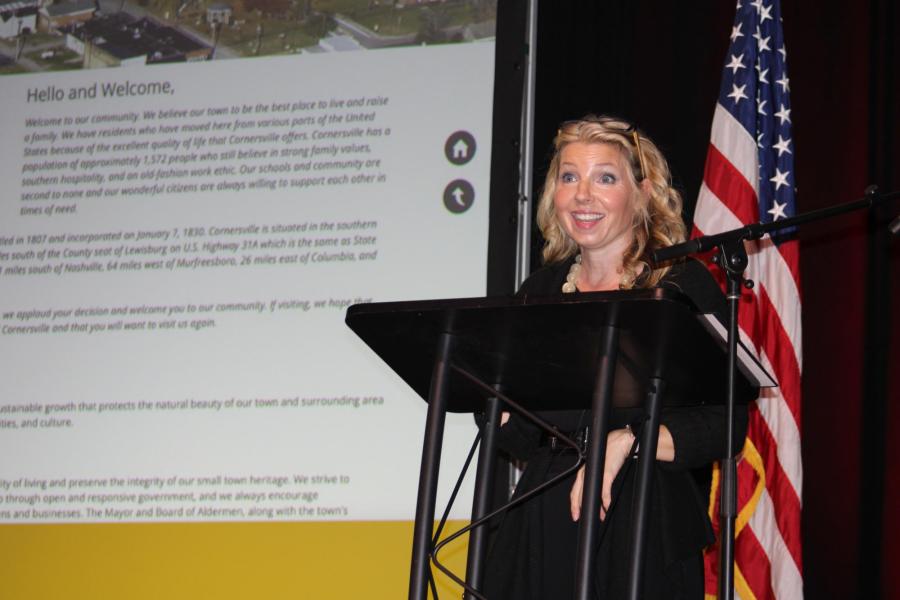
Hannah Harvey, a frequent performer at Jonesborough’s National Storytelling Festival, is a Blountville native with a doctorate in communication studies and performance ethnography from the University of North Carolina-Chapel Hill. She has worked with local entities like Kingsport’s Bays Mountain Park and Planetarium as well as internationally on storytelling initiatives and projects.

Harvey brought her skills to the Tennessee Municipal League’s annual Conference and Expo in Kingsport to discuss the ways municipalities can better communicate their own narratives.
“Everyone in this room is a storyteller,” Harvey said. “When we tell stories in everyday life, you are engaging in world travelling. You are inviting someone into a world. The same neurons in your head figure as if you were actually going to that place when you hear a story about a different place.”
HOW STORYTELLING WORKS
Harvey said there are biological reasons that stories resonate.
“Stories evoke emotion that impacts our decision making,” Harvey said. “It taps into our adrenaline and oxytocin, which then creates a physical response. Telling a story can create empathy and trust through a symbolic communication of values.”
Whether the purpose of a story is to recall the past or project an ideal future, Harvey said it is important to remember each story has a beginning, a middle, and an end, and storytellers must live “in the messy middle” of the story. Just as the beginning often represents the past and the end of a story represents its future, Harvey said the middle is representative of the present.
To tell an effective story, Harvey said leaders must take listeners from what things were like in the past to the future, highlighting how the goals achieved at the end of the story can help justify the frustration being felt in the present time.
One example she used was frustration citizens might have with an ongoing road building or construction project. By evoking an image of how that project will make life easier for citizens in the future, leaders can disconnect them from the negative emotions they feel about present construction woes and instead focus on the future positives.
“Stories stick with us,” Harvey said. “They give us continuity and trajectory for our lives. Simple stories, when well told, can grow your community. Give them stories they want to live into.”
THE IMPACT OF STORYTELLING
From recruiting new businesses, to writing grants, to fostering employee collaboration, to communicating with citizens, Harvey said municipal officials engage in a wide variety of storytelling.
“When you’re telling your community’s story, you’re giving other people a story they want to live into,” Harvey said. “You invite them into that story with your words and intonations. You are painting pictures in people’s minds when you tell stories. As a leader, a crucial part of your job is to tell your community’s story.”
While people often talk in lists and bullet points, Harvey said people are more likely to remember images as they stick with them.
“We are wired for visual imagery, and there is a lot of neuroscience to back that up,” Harvey said. “The goal of storytelling is to get the images in your head into someone else’s head. Pictures induce a more elaborative or associative encoding than ever occurs with words alone.”
Storytelling also engages in different types of memory, which is why people are more likely to remember the details of a story than that of a lecture. Harvey cited the storytelling used by the American 250 video “Tennessee: The Original Frontier(opens in a new tab)” put out by the state, which invokes several images of the state’s past and present with narration from country music legend Dolly Parton, as an example of how visual storytelling can create emotional responses.
“Stories and images are linked to values that we hold dear, that are deeply set inside us,” she said. “These stories and images connect us to shared values that bind us together. That video takes three minutes, but stories stick with us and lead our audiences back to the values that your community holds dear.”
STORIES THAT STICK
Visual storytelling can also take many different forms. One way to begin telling stories of a community is to add illustrations or photographs to a municipal website that connect to the municipality’s values.
“If you are trying to tell people ‘taxes are great here’ you need to show them what that looks like and tell them a story of what that concretely looks like for them,” Harvey said. “Leading with pictures tells people what it feels like for the ideal future they want to live into. If there is a project you need funding for, put people on a trajectory of images that help them dive into a story.”

Harvey also brought with her a coffee mug she bought in Chapel Hill, N.C., which features images of several area landmarks – some of which are no longer standing. While the representation of each place is simple, she said each illustration on the mug has the power to evoke memory and a sense of place as well as communicate the area’s values.
The first image on the mug is of the Horace Williams House, a historic house museum on the UNC Chapel Hill campus, which Harvey said invokes community values like education, history, and preservation. The second – the Coker Arboretum – is a natural space that connects to outdoor life, fresh air, and communing with nature. The third is Franklin Street, a retail area known for its holiday celebrations that portray values like lively gatherings, creativity, and eclectic sensibility.
The restaurant Crook’s Corner connects to local food culture and family farms, generational traditions, and a multicultural community. The last image is of the local retail story A Southern Season, which sells local and global items. She said this last place connects Chapel Hill to values like history, heritage, culture, global literacy, and travel.
Harvey then suggested officials visual places in their own community that evoke emotion or sense of place such as a historic landmark, a place in nature, a social scene, and a restaurant or local retail place that is iconic to the area. To begin telling a story, Harvey said you must first set a scene through visuals and sounds.
“Doing that takes maybe 30 seconds, but it animates a scene that communicates all these values,” she said. “Think about an important place in your community. When you go there, what does it smell like when you take a deep breath in? What does it feel like on your skin? Where is the light coming from? Are you indoors or outdoors? Is it hot, cold, damp, or itchy? Think about what you see physically in that place.”
By adding in people, Harvey said the story then becomes animated and provides core details people will remember.
“When you put people in that scene, ask what they are doing,” she said. “How are they moving in relation to one another? Are they running or sitting still? Are they standing? What is one value that scene represents for your community?”
The next time leaders want to talk about a community value, Harvey said start with describing that scene and see the immediate difference it makes.
“Once you take people to a place with a story, you share an experience,” she said. “Once you share an experience with someone, it changes the feeling in a room, what is possible in conversation, and draws people in. Your role in these stories and scenes is holding our communities together. You make our communities possible.”