
Eastman official shares perspective on how municipalities can grow workforce, industry
By KATE COIL
TT&C Assistant Editor
Municipal leaders gained insight into how they can best help local employers as workforce needs evolve.

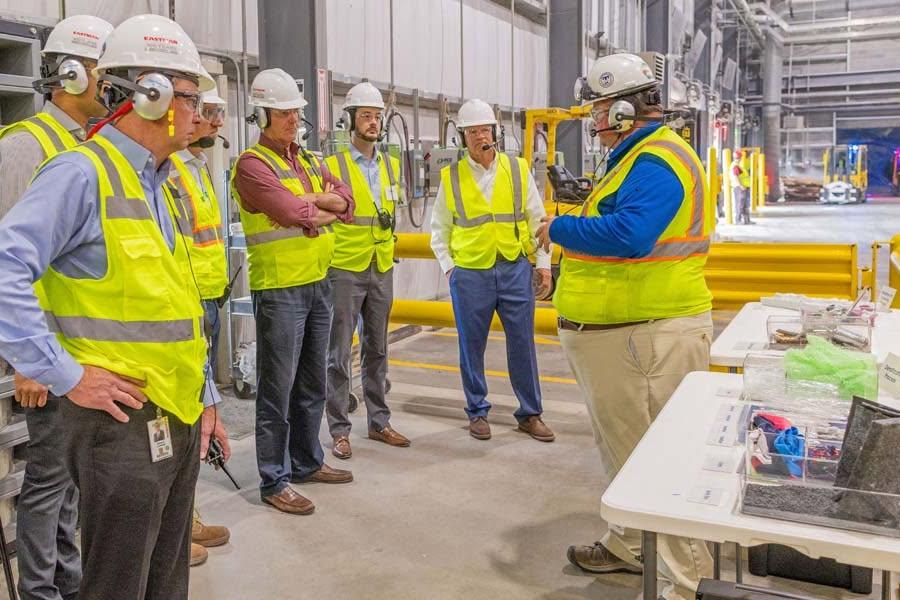
Adrian J. Holt, senior vice president and chief human resources officer with Eastman, addressed city leaders at the TML Annual Conference and Expo in Kingsport on how employers and government officials can collaborate to tackle major challenges faced in the public and private sectors.
“If you have lived and worked in different places, you learn two things: every community is unique and change does not wait for us to feel ready,” Holt said. “There is a third thing I’ve learned that might matter most of all: the moment you stop learning is the moment you start failing. That single idea has shaped my career and has shaped Eastman for more than 100 years.”
Founded by George Eastman as a subsidiary of Eastman Kodak in Kingsport in 1920, the Eastman Chemical Company was originally created to manufacture film, photographic paper, optical glass, gelatin, and other chemical products for use in film and cameras. Kingsport's reputation as the “Model City” comes from the architectural plan, known as a garden city, the company created for its workforce. Both the city and Eastman have grown and evolved together since.
“When Eastman spun off from Kodak in 1994, we had to do more than continue operations, as you can imagine” Holt said. “We had to define our own identity, establish our direction, and prove we could succeed on our own terms. We were not simply preserving an inheritance. We were creating a future, not only for the company and our employees but for this entire community. That experience, that independence, and requirement on all of us shaped something really important in Eastman’s culture. It gave us the confidence that we could adapt, reinvent, and keep moving forward, even when the path ahead was very uncertain.”
Now a multinational and independent corporation, the Eastman Chemical Company has remained integral to the city and citizens of Kingsport and is among the top 50 largest employers in the state.
“Today, Eastman has a much broader footprint than many realize,” Holt said. “We have customers, operations, and partnerships that reach well beyond this region to across the globe. Our roots are here in Tennessee and will always be here in Tennessee. That’s why that big site is called Tennessee Eastman and always has been.”
EMBRACING CHANGE
As a result of the changes Eastman has seen as a company and in Kingsport in the past century, Holt said he and the company have learned about resilience.
“Resilience is not abstract for us; it’s something Eastman has lived,” Holt said. “Resilience is not about standing still and hoping things settle or slow down. It’s about being willing to learn and evolve, often before you feel entirely comfortable doing so. In fact, often before you feel ready or that it’s even necessary to do so.”
Some of the biggest changes Holt has seen in the past several years have stemmed from labor shortages, intense competition for talent, and major shifts in what employees expect from their employers, particularly since the pandemic. Between late 2021 and 2022, Holt said Eastman could not hire enough people to keep pace with what the company needed. Just as that became manageable, he said artificial intelligence added a new dimension to the workforce.

At the same time, he said Eastman has been dealing with the changing nature of the chemical industry such as unpredictable global supply chains, increased energy costs, and demands from customers for more sustainable products and social responsibility. Geopolitical tensions have also disrupted key trade routes Eastman relies on, which means events far from Tennessee can deeply impact operations.
“With those challenges also come opportunities,” he said. “If we are agile and nimble, and if we can compete better here in Tennessee, we can push ourselves ahead of others. It changes not only what companies produce but how they produce. Attracting and retaining the kind of talent we are going to need to succeed at Eastman has meant evolving with the industry. We’ve had to invest in new technology, advancing more sustainable and circular solutions, modernizing our operations, and building a workforce with the technical, digital, and leadership skills to be successful in this new environment.”
EVOLVING WORKFORCE NEEDS
In recent years, Holt said there has been a dramatic change in corporate culture.
“When the ground is shifting both outside the company and inside the workforce, you find out very quickly whether your organization is able to adapt,” he said. “For us, that has put a premium on a few fundamentals: trust, clarity, flexibility, and continuous learning. There has to be a willingness to invest in people before the pressure is on.”
Holt said the pandemic put an emphasis on these needs, particularly as city leaders pivoted to meet the needs of their communities.
“We, the employers, and you, the city leaders, had nowhere to run. We had to make sure everything carried on, and you did. COVID never really ended with a big day. I want to say to you ‘thank you’ on behalf of all the employers in Tennessee. I hope you recognize yourselves for the two years you put in without a day off. What mattered then was not pretending to have all the answers; it was being honest and visible, communicating clearly, telling the information we had at the time, and making it plain that safety and well-being came ahead of everything. Simple things matter enormously in those periods. Trust is a leadership asset in a company, and it’s a civic asset in a community. Once you’ve built it, people are willing to go through a great deal with you. Without it, even the smallest changes are hard.”
While the labor market is less frantic than it was during the pandemic, Holt said employee expectations have changed permanently. Employees are demanding more flexibility and more return investment from their employers and communities.

“They want to know that if they invest their time and energy in your organization, your leadership, you are equally invested in their future. The workforce we need today is not the workforce we needed ten years ago, and it’s not the workforce we are going to need in ten years’ time. We need people who can learn, adapt, collaborate, and move with business as it involves. My job since 2020 has been sort of a chaos manager, as I’m sure it has been for you. The people who have been more successful are the ones who manage chaos and even really thrive in it. Here in Tennessee, we do it better than any state.”
Holt said skills potential matters as much as, if not more than, credentials. He said many of the resumes he receives today are clearly written by AI, and he has started conducting all interviews in-person to stop candidates from using AI tools to answer difficult questions.
He predicts apprenticeships, technical pathways, community college partnerships, internships, and reskilling programs are going to become more important for companies. He also said there needs to be a shift to allow people to grow into roles rather than hired directly for them.
Eastman works with Kingsport-area high school students, who make $15 an hour working four hours a day at Eastman while still attending school. Of those 119 students, 14 students have moved into full-time roles, eight into maintenance training and positions, and several have gone into internship programs.
“Key for me is that I don’t care if all 119 of those students come to Eastman or not,” he said. “If I’m building a flow of young people who are trained in modern technology and modern roles who are going to be employed for the next 20 to 40 years, I don’t mind if they go into any of the other businesses around here. I think the tide raises all boats. It is helping us build that talent locally, early, and address key shortages like machinists. The truth in a competitive market is that you rarely hire your way out of every problem. Sometimes you have to build the talent on your own.”
To grow the skill base and workforce companies like Eastman need, Holt said they must rely on partnerships with educators, civic leaders, local governments, chambers of commerce, and economic development organizations.
“Talent does not just follow jobs,” he said. “It follows opportunity and quality of place. On behalf of an employer, it’s the quality of place, confidence of opportunity, and growth of feeling you get about a place that brings people in, not just in the jobs.”
REGIONAL DEVELOPMENT
Holt is a new member of Building Regional Investment, Development, Growth, and Engagement (BRIDGE), a privately funded economic development organization dedicated to growing the regional economy of Northeast Tennessee and Southwest Virginia. The goal of the organization is to help communities on both sides of the border compete economically as a region rather than as individuals.
“Small communities in far corners of a state don’t always get the visibility they deserve. BRIDGE was created to help change that. We see that in the expansion at the Tri-Cities Airport, which allows people to fly to Washington, D.C. several times a day. It improves connectivity, grows business, and strengthens our attractions. It makes this region more competitive. Regional partnerships can align interests and create momentum. BRIDGE also shows the power of public-private partnerships. When business, government, education, and civic leaders come together around shared priorities, regions are more likely to grow.”

When potential employees are considering where to work, Holt said they aren’t just looking at companies but also at schools, housing, childcare, transportation, broadband, healthcare, and the community.
“We are so fortunate to work with community leaders who understand economic growth is not only about recruiting the next employer or announcing the next project,” he said. “It’s also about addressing the practical issues that shape where and how people build their lives.”
Holt credited Kingsport leaders including City Manager Chris McCartt, Mayor Paul Montgomery, and former Mayor Pat Shull for seeing an emerging need for dentists in rural Appalachia. Together, they worked to establish the University of Tennessee Teaching Dental Clinic in Kingsport, which now provides vital, free dental care to hundreds of underserved individuals in the region. Holt said his own son participated in the program, learning much more than just the dental industry.
Similarly, city leaders also worked to establish a childcare development center because a lack of childcare was limiting the ability of local companies to recruit. While these may seem like community initiatives, Holt said they are also important to the workforce.
“When local leaders step up to address challenges like childcare or affordable dental care, they are doing more than supporting local families. They are stretching the region’s ability to attract talent, support employers, and sustain growth over time. People have to feel that if they are going to invest and move here and settle here that cities across Tennessee are excited for them to come.”
Ultimately, Holt said he anticipates the communities and companies that will thrive in the future will understand the that talent, economic development, and placemaking are all important parts of the same conversation.
“The places that will thrive are the ones that will ask, with honesty, what do we need to do differently now, not because the past was wrong but because the future won’t wait for us. Resilience is not a trait you have or you don’t. It is a practice, and like any practice, the more you do it, the better you get it. You built it in how you lead, hire, partner, invest, and how willing you are to adapt and learn.”