

State Funding Board approves more optimistic growth rate
By KATE COIL
TT&C Assistant Editor
The State’s Funding Board set a growth rate higher than last year’s projected numbers(opens in a new tab) and more in line with the state’s average growth range of 3-5%, though concerns like consumer confidence, geopolitics, and the impact of artificial intelligence (AI) could all impact the state’s economic outlook.
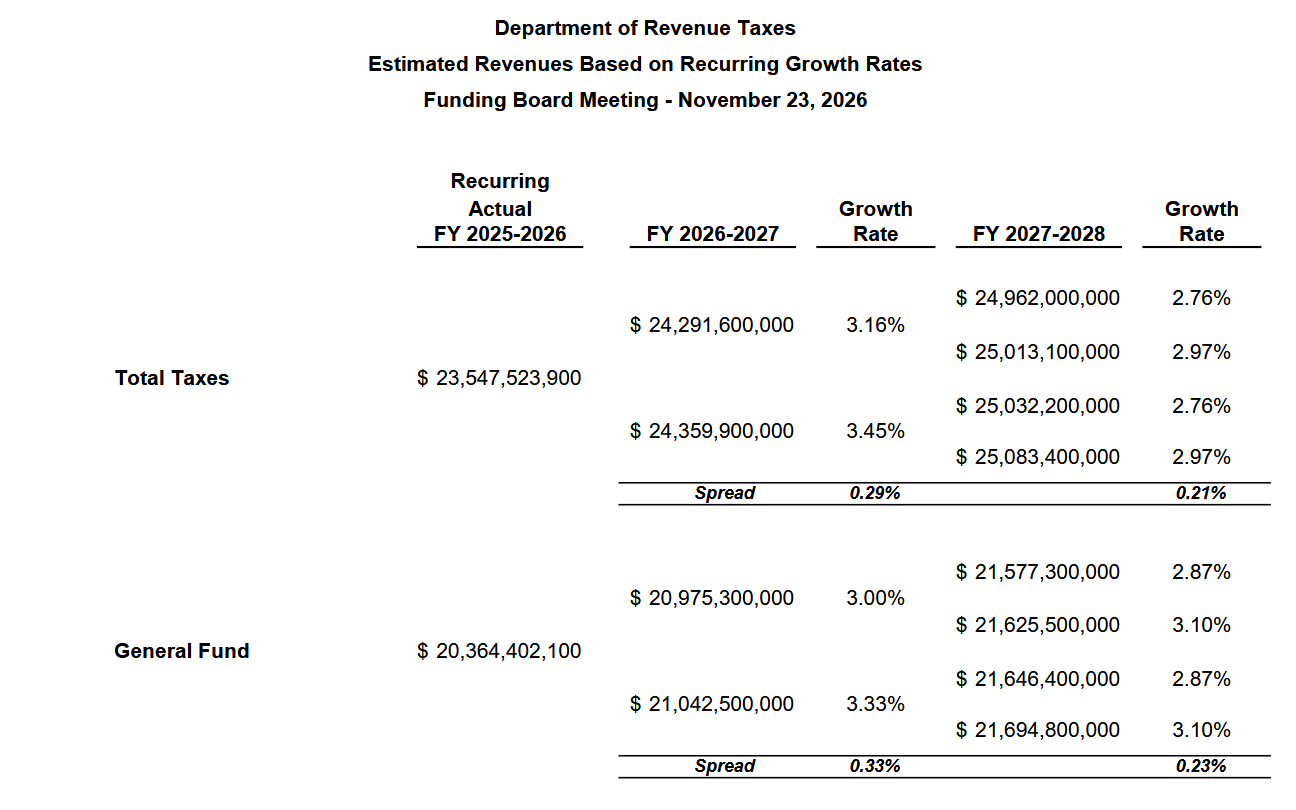
Finance and Administrator Director of Budget David Thurman said staff recommended(opens in a new tab) the approval of:
- A growth rate range of 3.16% to 3.45% for total taxes in Fiscal Year 2026-27
- A range of 3% to 3.33% for the general fund in Fiscal Year 2026-27
- A range of 2.76% to 2.97% for total taxes in Fiscal Year 2027-28, and
- A range of 2.87% to 3.10% for the general fund in Fiscal Year 2026-27
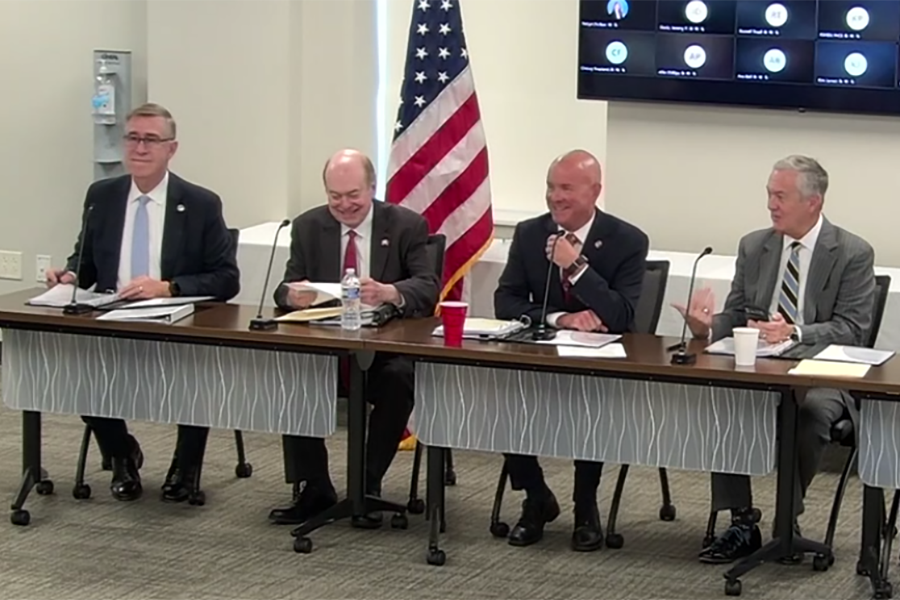
Attending board members Comptroller of the Treasury Jason Mumpower, Finance and Administration Commissioner Jim Bryson, Secretary of State Tre Hargett, and State Treasurer David Lillard approved the recommendations unanimously 4-0 at the Nov. 23, 2026, meeting.
Based on these projections, in Fiscal Year 2026-27 total tax revenue could range from $24.291 billion on the low end to $24.359 billion on the high end while general fund revenues could range from $20.975 billion to $21.042 billion. Projections for Fiscal Year 2027-28 range from $24.962 billion on the low end to $23.083 billion on the high end for total tax revenue and from $21.577 billion to $21.694 billion on the high end.
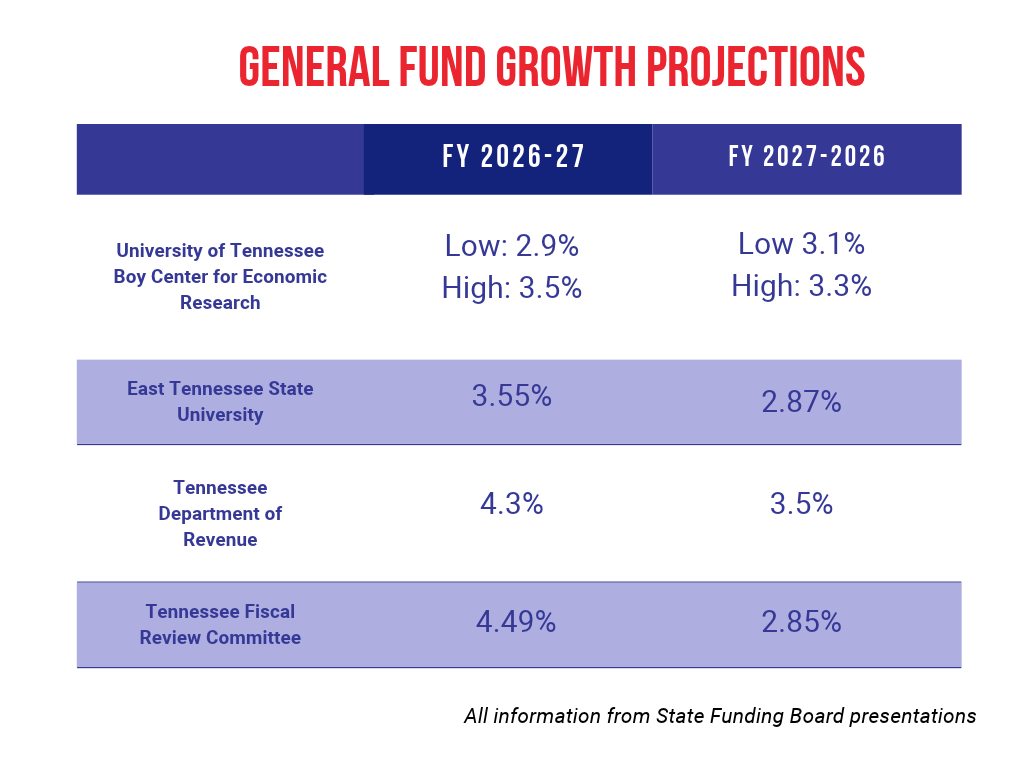
Projections from a panel of experts(opens in a new tab) predict state general fund revenues could grow by 2.9% to 4.49% for the 2026-27 fiscal year and 2.85% to 3.5% for fiscal year 2027-28.
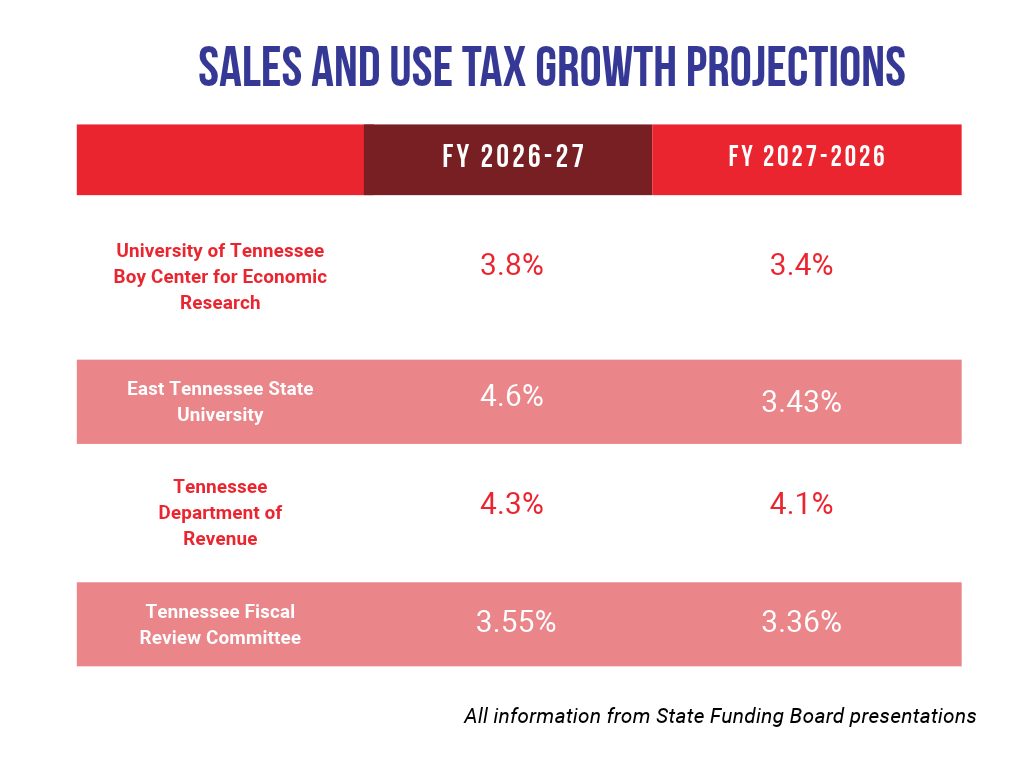
Predictions for sales and use tax revenues also ranged from 3.5% on the low end and 4.6% on the high end for fiscal year 2026-27 and 3.36% on the low end and 4.1% on the high end for fiscal year 2027-28.
Experts providing presentations to the panel included Dr. Don Bruce, professor of economics and director of the UT Boyd Center for Business and Economic Research; Dr. Joseph Newhard, associate professor of economics at East Tennessee State University (ETSU); Dr. Aryaman Bhatnagar, assistant professor of economics at ETSU; Tennessee Department of Revenue Director of Research Jeff Bjarke; and Tennessee Fiscal Review Committee Chief Economist Elizabeth Bransford.
FRANCHISE AND EXCISE
Bruce noted that inflation is largely propping up the state’s revenues and while the current economic situation may seem positive for the state’s revenue growth, there are longer-term consequences to also consider.
 “Remember, a big part of our tax revenues are based on prices,” Bruce said. “Inflation is not necessarily a bad thing for revenues. When you have a sales tax that is a function of prices and quantities, inflation usually translates to higher revenue growth, but it also translates to higher expenditure growth for the state budget as well.”
Bruce described franchise and excise taxes as the “absolute wild card” in the state’s economic future.
“We have never seen confidence intervals as large as they are with franchise and excise right now,” Bruce said. “We actually could literally see very large double-digit losses and very large double-digit – even triple-digit – gains in franchise and excise taxes, which are not a small part of our revenue pie. We are talking about $4.5 billion to $5 billion in collections that could be up or down by 50%. Year-to-date, they are up 75% based primarily on estimated payments.”
Bjarke agreed that there was the potential for great revenue growth and decreases, largely contingent on franchise and excise collections. While franchise and excise collections were up around 25% for the 2025-26 fiscal year, Bjarke said timing plays a major role in that number. He said in the first quarter of 2025 these collections were down 4.3% but are presently up 75% because of rapid growth.
“We are having to compare to the old model before this surge got to us,” he said. “In contrast to last year, it has shifted more toward the proportions we expect. A lot of that is because franchise and excise was up over last year.”
Bjarke said franchise and excise is “far and away the most volatile” part of projecting state revenues with these taxes accounting for 20% of the state’s revenues.
“Some of why it is hard to forecast is the backward nature of it and the timing,” he said. “We are up 75% give or take in collections, and most of that – almost all of it – is an increase in estimated payments. We have very little information about estimated payments. We get them, count them as collections, but we don’t know what the final tax liability is until we get the final returns.”
Francise and excise taxes are paid based on tax year rather than calendar year with payments coming in throughout the year based on extensions, which can last as long as seven months. The 2025-2026 fiscal year is also the first year these collections rely solely on sales. However, Bjarke said the state is continuing to see high estimated payments.
“There is a big chance those estimated payments could be overpayments and we have to deal with [the question] are they refunds or do we count them toward next year,” he said.
INFLATION AND SPENDING
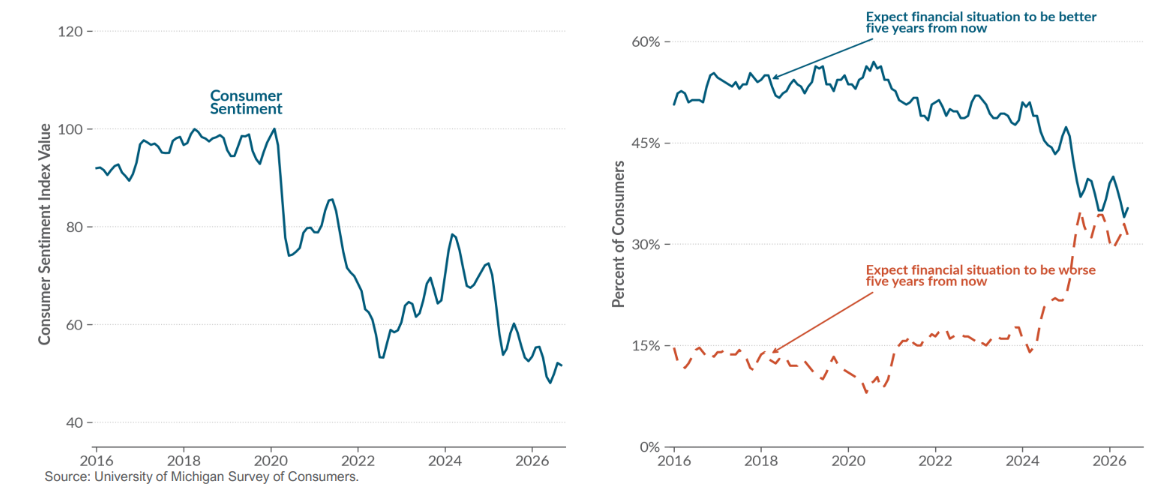
Consumer confidence - or lack thereof – and inflation are among the primary drivers of the state’s revenue projections.
Bruce said that growth remains slow but positive with inflation remaining stubbornly high, driven primarily by oil prices and tariffs. Oil and fuel prices are driving up inflation in other sectors including food, energy, commodities, and services.
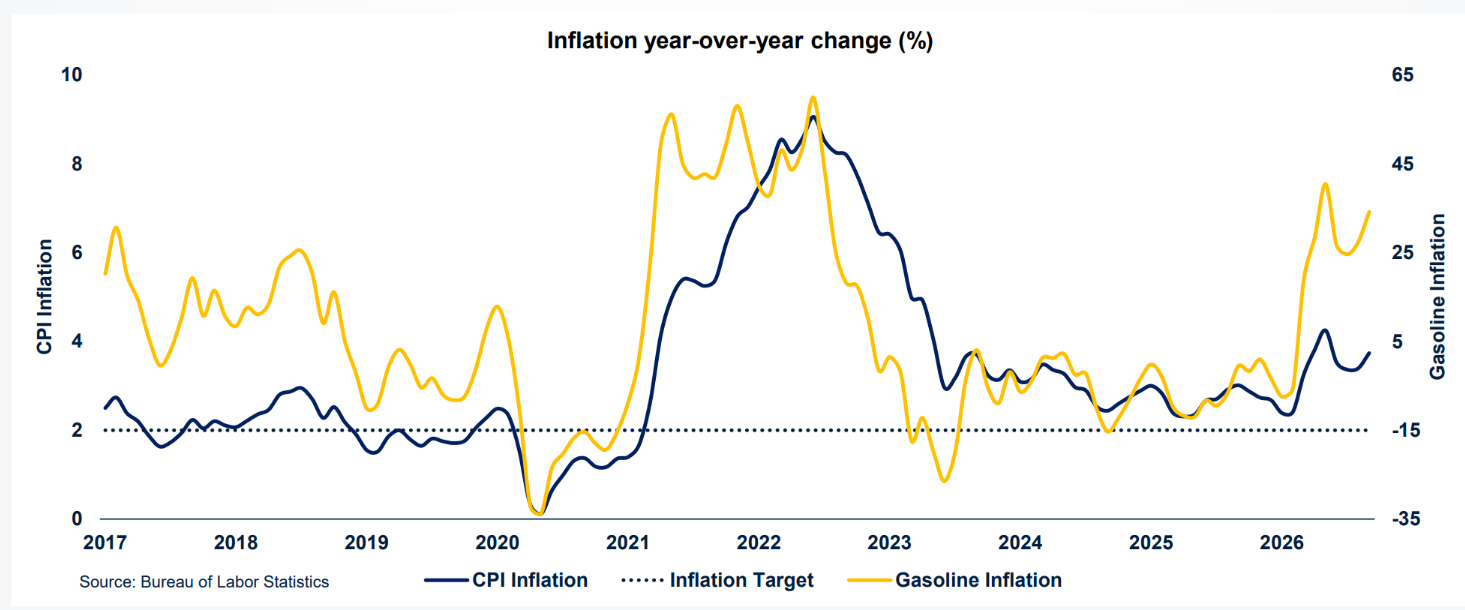
As a result, Bruce said it is unlikely the Federal Reserve will cut interest rates and more likely that one or two rate increases may be on the horizon. Wage growth is not keeping up with inflation, which Bruce said lowers the purchasing power of the American consumer.
Bhatnagar agreed that gas and fuel prices are driving inflation across various sectors, but added factors at play.
“It’s not just prices alone; it’s a combination of three different things: prices, income, and borrowing costs,” he said. “The problem consumers are facing is that price level itself has been above trend since the pandemic. At the moment, we are 16% above trend when it comes to inflation.”
With tariffs at the highest rate since the 1940s, Bruce said tariff rates could positively impact state revenue collections but negatively impact domestic production and other economic factors.
Bransford noted that exports have decreased each quarter of 2026 but imports continue to increase quarter-over-quarter by nearly 2%, demonstrating strong consumer spending. While tariff rates are beginning to come down, Bransford said the dynamic of the current geopolitical landscape makes it difficult to predict long-term tariff trends.
Recent court cases have also impacted tariff collections with the ordering of refunds to companies that have sued the federal government.
“Generally, refunds have been less than $1 billion prior to October 2025 with the occasional threshold surplus, but we have seen a tremendous spike in these refund amounts, largely due to the federal administration declaring the U.S. trade deficit a national emergency in April 2025 and imposing reciprocal tariffs under the International Emergency Economic Powers Act (IEEPA),” Bransford said. “The U.S. Supreme Court handed down a ruling in February 2026 saying that the right for the president to impose tariffs does not exist under the IEEPA. There have been ongoing attempts to impose more tariffs with the Supreme Court striking them down. With the ongoing litigation to reclaim dollars already paid, striking down of newer tariff implementations, and the long refund process, it is likely that higher refunds will continue into the next year.”
Housing prices are starting to decline, partially because of a slowdown in demand due declining population growth and partially because of an increase in the housing supply. Bruce said this is rebalancing supply and demand, but high-growth pockets of the state are still facing affordability issues. He said new housing supply can help improve affordability.
LABOR MARKET TRENDS
While Tennessee continues to enjoy job and population growth, the state is still stymied by a mismatch in where new jobs are located and where the individuals with the skills for those positions are living.
Bruce said the labor market is finally back into positive growth territory but this growth has been fairly slow. The state has grown its labor market by 8% since the pandemic, outpacing the national rate of 5.2%. As a result, Bruce said if every unemployed person in the state were to be hired tomorrow, 15,000 to 17,000 positions would still need to be filled.
“The problem we are facing is that those jobs are not in the right area for the available workers and are not perfect skill alignment with the workers who may be available across the state of Tennessee,” Bruce said. “That is still a much better equilibrium picture than we had even a couple of years ago. Unemployment rates remain near historic lows in Tennessee.”
However, the labor force participation rate has continued to decline in Tennessee and nationally. Bruce said this decline is primarily driven by those age 55 and older. At the same time, the number of people between the ages of 25 and 55 who are participating in the labor force is at an all-time high.
Bruce said Tennessee’s average income is rising to meet national rates with the state’s average annual income for 2026 at $69,131 compared to the national average of $76,393. Part of this wage growth is driven by lower labor force participation rate with employers raising wages to keep the employees they have.
While incomes are increasing in dollar amount, Bhatnagar since 2023 national and state real income growth – meaning how much value people are getting per dollar – is close to zero. With earnings not keeping up with inflation, consumer borrowing is increasing along with the cost to borrow.
“We have seen prices are high, incomes are not catching up, and borrowing costs are high, so why is there such strong GDP?” Bhatnagar said. “Unemployment is at historic lows, though the labor force participation rate is also at historic lows. This does not explain why GDP is going up alone. When prices are going up but income is not, consumers have a few choices. Either they reduce consumption – which they are not doing – or you use savings, which is exactly what is happening. Savings rates are going down, and this has been driving growth for the last few years.”
While savings from the pandemic have kept the GDP afloat, Bhatnagar said those savings are nearly exhausted so many households have begun taking on additional debt. Bransford said a recent survey by credit card company Visa – which covers 52% of the American credit market – found 1.2% spending in discretionary spending and a 0.2% increase in non-discretionary spending while savings rates fell 4.6% year-over-year.
“As spending has been resilient and persisting through inflationary pressures, the savings rate has been a consistent decline,” she said. “Savings hit a peak in 2020 as economic uncertainty resulting from the pandemic was looming over consumers. The average savings rate in 2020 was 15.1% while the savings rate at the beginning of this calendar year was at 5.6% and fell to 3.8% by September.”
AI’S ECONOMIC IMPACT
Investment in AI and whether those investments will bear fruit is another concern for the state’s economy.
Bruce said a lot of GDP growth in the Southeastern region has been driven by AI, though many economists have expressed concern that AI is “a large and growing bubble that may well pop.”

“I think one thing about Tennessee’s economy in this post-COVID economy is that we are a very well diversified economy,” Bruce said. “We are a lot more recession ready when it comes to employment growth, economic growth, and overindulgence in AI and the tech sector. We want a piece of it, and we are getting a big piece of it, but it isn’t the only game in town.”
Bhatnagar said broadly 20% of U.S. GDP is created by AI use in software, data centers, power and computer equipment, both directly and indirectly. At present, Bhatnagar said AI is fueling three major channels: jobs, investment, and wealth, particularly in the financial market.
The investment by xAI in Memphis and Oracle in Nashville, as well as data centers statewide are contributing to Tennessee investment. While Bhatnagar said the number of jobs aren’t exactly increasing due to AI, productivity is. However, the biggest increase is being seen in wealth and investments with many Tennesseans seeing more money in brokerage accounts or 401K because of AI’s impact on the stock market.
“AI is essentially leading to higher profits and expectations of profits, which leads to higher stock prices,” he said. “Most people own brokerage accounts, and since their wealth is going up on paper, they end up consuming more. That is what is driving consumption.”
For now, Bjarke said AI has been a positive for state revenues.
“AI has emerged as a big, taxpaying sector in Tennessee,” Bjarke said. “I think we have a mixture of risks. This could continue to accelerate and increase our collections, but also because we have had so much of our growth around these sectors and these payments.”