

State officials forecast future of data, A.I. in aiding in disaster responses
By KATE COIL
TT&C Assistant Editor
As severe weather events across Tennessee increase, state officials are incorporating artificial intelligence (AI) and other technology into emergency responses and exploring new ways technology can aid in preparing for and recovering from future disasters.

When Winter Storm Fern struck Tennessee in January, the storm contributed to the death of 30 Tennesseans, cost hundreds of millions in damages, and led to disaster declarations in all 95 counties, which is very rare for a single natural disaster.
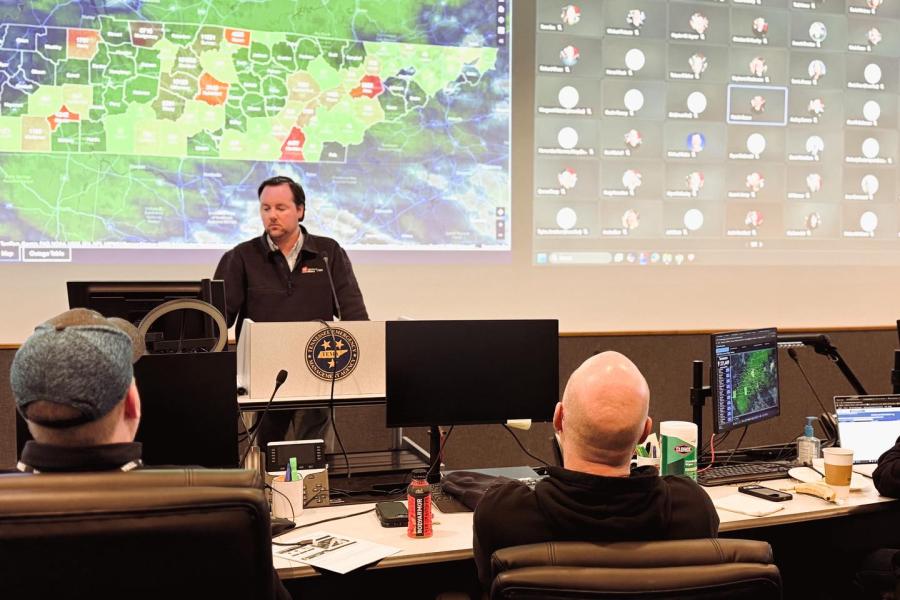
During the session “Mission Critical: The Role of IT in Statewide Disaster Response” at the Tennessee Digital Government Summit in Nashville, state officials from the Tennessee Emergency Management Agency (TEMA), Tennessee Department of Health (TDH), and Tennessee Bureau of Investigation (TBI) discussed how technology aided in coordinating the disaster response and recovery.
IMMEDIATE RESPONSE
Dr. Paul Peterson, director of TDH’s Emergency Preparedness Program, said one of the first major concerns when any natural disaster strikes is the human cost. Power outages, like those caused by Fern, are felt acutely by those who are rely on electricity-dependent medical devices and services.
“When we have those kinds of extended power outages, it puts all of us at risk,” Peterson said. “There is a more traditional definition of an at-risk population, but dependent on the event and your own personal readiness, it can put you at risk. One of the things we focused on early was our healthcare continuum. We had power outages across the state impacting long-time care facilities with generator failures. We had dialysis patients who could not get to their dialysis appointments – not because the center wasn’t open but because public transportation wasn’t available. Also, we had hospital surges where people were going to hospitals to charge their phones, warm up, and for a variety of things. We also have people on home-based oxygen who couldn’t power up and had to go to warming shelters.”
To serve those individuals, Peterson said the health and medical side of the disaster response – known as ESF-8 – works with partners to coordinate where medically fragile Tennesseans can best be served.
“An effective response is really based on updated situational awareness. That is generated based on testing the system, trust, and relationships. If we don’t have those things, then we are struggling. We have a variety of teams of folks across the state who were engaged and used a lot of different tools.”
While TDH uses Microsft Teams chats day-to-day, a specific channel was created for disaster response information allowing information to be quickly disseminated statewide. The healthcare resources tracking system allows TDH to know where beds are available for patients statewide, helping determine what hospitals were open, which had generator failure, and which did not have electricity. This information allowed TDH to tell patients where they could go to receive services and also provided important details needed for the state to secure a federal disaster declaration.
By seeing what resources hospitals and emergency providers needed, Peterson said TDH was able to fill those gaps and prevent many hospitals from having to evacuate. Knowing where beds were available also helped find space for the 300 people who did have to be evacuated from other locations.

Discharge data from emergency departments across the state also helps aid in response. If an increase is seen in hospitalizations due to carbon monoxide, hypothermia, or falls, TDH can then create public messaging targeting those areas.
“We had a lot of different data inputs,” Peterson said. “With all of those different things, we have to structure our response. I can’t underscore the importance of us all sitting together at [the Tennessee State Emergency Operations Center] sharing resources back and forth across state agencies. It’s critical. In these types of responses, speed is what it is all about.”
AFTER THE STORM
TEMA Chief of Staff Alex Pellom said Fern presented a unique challenge as the weather did not immediately warm up enough for damage assessments to begin, and instead was quickly followed by a second wave of storms.
“As buildings, facilities, and infrastructure are damaged, we have to go out and chronicle what they are, where they are, and levels of damage because that is the basis of how we make the decision whether the governor will request a disaster declaration,” Pellom said. “Those disaster declarations are what brings aid to our government to replace roads and bridges, like those that were washed out by Hurricane Helene. The other part of the disaster declaration is the individual assistance for people. There is utmost importance for us getting this done, getting it right, and getting it done quickly.”
For decades, the process has required TEMA officials and employees to physically go to areas with maps, checklists, and paperwork to fill out to submit to the federal government. TEMA then used GIS technology to enable local emergency management officials to go out in their own jurisdictions, take photos of damage, upload them to the statewide system, and add any data they have collected.
In turn, Pellom said all the information collected through the GIS database can inform future decisions beyond securing a declaration.
“If I can see that one house has major damage, I can then equate that damage to 75% of the houses in that area,” he said. “We can estimate that data in real time to expedite the declaration process. This is revolutionary in the way you do damage assessment. You can see where damage took place and reassign resources where they need to go. This gives us the situational awareness of what we are looking at to see what decisions we need to make.”
Fern cut off some areas for weeks, so TEMA built a GIS dashboard that was open to the public. Residents could submit their own photos and fill out a simple questionnaire. Pellom said the dashboard served as a force multiplier, crowdsourcing important data.
“By giving the public the ability to do this, we don’t have to wait. We know where people are affected. We may think one thing, but when a bunch of dots start popping up, we can see where communities have been cut off. We can then reach out to first responders and community organizations who respond to disasters and push resources to these folks. This became a gamechanger. While it doesn’t verify anything, it brings awareness and brings it quicker.”
FORECASTING THE FUTURE
TBI Assistant Director for Technology Richard Littlehale said the agency is available to TEMA whenever a disaster strikes. TBI has resources for taking in, organizing, distributing, and acting on information, such as hotlines and data analysts.

During Winter Storm Fern, TBI initially created an intake mechanism for residents reporting welfare concerns about family, friends, and neighbors and requesting check-ins. TBI also uses AI through a federal tool known as Virtual Command Center, which helps process information from calls and direct that information to the best agency to respond.
However, an insurance company incorrectly announced that TBI’s missing persons hotline was helping to process missing public aid funds – also known as welfare checks. As a result, many people began calling the hotline for this purpose as well. Litthehale said this created a real problem.
“All of a sudden, our hotline – which is robust but not endless – was deluged with calls all at the same time,” Littlehale said. “This was a microcosm of a real problem as we think about the future of AI. There are 911 centers right now that are using AI to triage life safety calls. You may think this is a risky way to use AI, but on the other hand, what are the life-safety implications of hallucination, of a misroute call, or a call that doesn’t get answered for 30 minutes? We have to have that conversation and look at it through clear eyes.”
Littlehale said there needs to be balance between over-reliance on technology and refusing to explore how technology can provide crucial aid.
“We shouldn’t embrace technology for its own sake but also not blind ourselves to the possibility,” he said. “Very often, it is the most vulnerable people in our society who are going to eat that sandwich. If you are in the disaster response business, the decisions you make, how agile you are, and how quick you are has people’s lives in the balance.”
Looking toward the future, Littlehale said research is underway to determine how AI and technology can better serve first responders using cloud-based data.
“One of the things that is a fascinating field in AI is a model that provides an advised set of tasks to responders in the field,” he said. “Imagine your goal is to make sure every first responder is doing what they can do with their bravery and expertise. How we can take that paperwork off them as much as possible and direct that they need to go to this place, and then this place, and then take care of themselves by having a snack and warming up. We can change from sitting around waiting to hear what you need to do to instead deliver the maximum amount of resources on target for the people who need them to most.”
Littlehale said he thinks AI technology will also help more effectively ingest information submitted during major incidents ranging from Amber Alerts to traffic crashes to mass casualty events. That information can then be more quickly processed through AI to help responders save lives.
Petersen said he foresees AI being used to improve how private and public healthcare responders connect and share information, particularly as more is developed to preserve patient privacy.
Pellom said he hopes to see technology develop to expedite the damage assessment process.
“Recovery takes a long time, and every step we can take to make it quicker gets these rural economies going,” Pellom said. “It gets people back on their feet and schools back in session. If I can fly over a damaged area and utilize the footage it finds, I have made damage assessment exponentially faster. We can have this data and these layers. What we need is to be able to process it quickly and effectively.”