

How TNSDC's Tim Kuhn finds the story behind the numbers
By KATE COIL
TT&C Assistant Editor

Executive Director of TNSDC
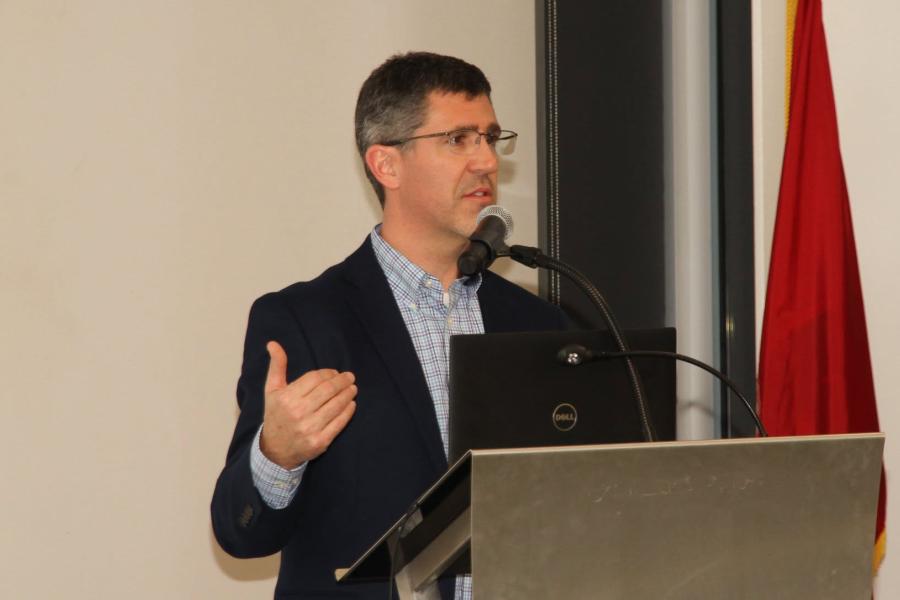
A frequent speaker at Tennessee Municipal League conferences, district meetings, and workshops, Tim Kuhn serves as director of the Tennessee State Data Center (TNSDC), which is housed in the Boyd Center for Business and Economic Research at the University of Tennessee in Knoxville.
Kuhn oversees operations of the data center, including the outreach and dissemination of U.S. Census-related material, and he serves as the state’s representative to the Federal-State Cooperative for Population Estimates, which was formed to promote cooperation between the states and Census Bureau in the preparation of the nation’s population estimates.
A graduate of the University of Iowa with a bachelor’s degree in political science, Kuhn’s work has focused on geographic information systems, web technology, census programs, and enrollment projections. Before joining TNSDC in 2018, he spent 18 years as manager of GIS and web design for the Knoxville-Knox County Metropolitan Planning Commission.
Tim resides with his family in Knoxville. After hours you can find him carefully monitoring the weather service radar, working in the yard, or occasionally on a small tributary of the Tellico River in Monroe County.
TT&C: A lot of your background is in geographic information systems (GIS), web technology, and data projection. What first interested you in these fields, and how have you turned it into a career?
Tim Kuhn: When I first began working in local government, GIS was just emerging and it wasn’t really a career. At that point it was so new that it felt more like a tool looking for people willing to try things with it. I remember using some early Census TIGER data to estimate the population near a proposed greenway. It was an incredibly simple analysis by today’s standards, but the data, the tools, and the hardware were all just arriving and it started to open eyes about what was possible.

I’d always been fascinated with maps, and after that I was hooked. GIS became a way to organize data, display it, and answer questions we hadn’t been able to before. I’m a generalist at heart. Those technical skills opened the door to working with other kinds of data and tools used for planning and communication. I’ve been fortunate to be able to use all three in ways that hopefully help people better understand the trends and events shaping their communities.
TT&C: For those who are unfamiliar, what are the goals and objectives of the Tennessee State Data Center?
TK: The State Data Center (SDC) program operates in all states. Tennessee’s is a long-running partnership between the U.S. Census Bureau, the state of Tennessee, and the University of Tennessee’s Boyd Center for Business and Economic Research. When the SDC program first began, its focus was on providing data before it was more broadly available on the internet.
We still help to disseminate data but also make custom products and provide expertise in Census Bureau data and tools for state and local agencies, businesses, nonprofits, and the public. I have quite a bit of interaction with the Bureau through the SDC program and a second initiative called the Federal-State Cooperative for Population Estimates. That gives us a deep understanding of the products and, in some cases, a chance to provide input or review releases.
TT&C: What do you find most interesting about your work? '
TK: Working with people across Tennessee in government, academia, and business has been really rewarding; when you pick up the phone, you never know who’s going to be on the other end of the line. It has been fascinating to get to know the little details of a state that’s so incredibly diverse in terms of its economy, its population, and geographically.
TT&C: TNSDC is the state clearinghouse for the U.S. Census. Walk us through what the organization does before, during, and following the U.S. Census every decade. How does the federal census inform your work in non-census years?
TK: The decennial census is vitally important, and its significance really can’t be overstated. Apportionment and redistricting are just the tip of the iceberg for how the data is used. Ahead of the 2030 Census, we want state and local governments to know they can review the data used to conduct the Bureau’s count through programs such as the Local Update of Census Addresses.
Leading up to the count, we help promote participation across Tennessee. And when the data comes out, we’ll help review the results and help communities challenge errors if needed. In the years between counts, the decennial is the foundation almost everything else is built on. Population estimates, the American Community Survey, and most federal funding formulas all trace back to it. Its accuracy shapes Tennessee communities for the entire decade.

TT&C: Many people know TNSDC for its work with the U.S. Census, population estimates, and projections. What is unique about the way Tennessee’s population is changing compared to other states and how does that impact the work you do?
TK: Every state has something compelling or unique about its population change and what’s driving it. That’s especially true in Tennessee this decade, where we saw a series of population events unlike anything in the state’s history. We recorded our largest single-year population increase in 2024, saw a record influx of new residents from migration, and experienced an early-decade pandemic that set off a whole series of unexpected events. It’s been fascinating to watch that unfold in real time and to try to draw attention to it. Midway through the decade, Tennessee’s fundamentals look to be back on a normal trend of steady population increase.
TT&C: What do you think are some of the biggest misconceptions people have about Tennessee’s population and its projected growth?
TK: I think there’s a broad perception that Tennessee is a retirement state. While we get more than our fair share of retirees because of our climate, living options, and cost of living, it’s a comparatively small share of the people moving into the state each year. Somewhere between 80 and 90 percent of our net migrants are younger than retirement age.
I also always get a kick out of the claim that two-thirds of the country’s population is within a day’s drive of Tennessee. We do have a good central location in the U.S., but those numbers have tended to drift upward over time, to my amusement.
TT&C: A lot of your work involves taking complex data and turning it into a format that is easy to understand for the public. What are the biggest challenges you encounter when doing this?
TK: I say this in all seriousness, but you have to make it simple enough that even I can understand it. The process involves narrowing the focus to a few key points and then getting comfortable with the fact that the reader won’t miss what you leave out. One thing that helps is that we are very clear about who our audience is.
We generally try to make things consumable for government officials, analysts, and the public. I don’t come from academia – I worked in local government for over two decades, so my natural inclination is to communicate with a non-academic audience through easy-to-read text, visuals, and maps. You can usually tell when you haven’t succeeded, because articles end up too long.
TT&C: The center has published articles on a wide variety of topics ranging from birth rates to population aging to how many Tennesseans work primarily outdoors. How do you find the bigger story behind data sets?
TK: Finding the bigger story behind data sets is actually the easy part. When we look at a new dataset or an updated release, we find what makes it relevant to Tennessee and what the new data tells us about what’s happening in the state. That can be something that sets Tennessee apart from other states, or how patterns vary across the state. It can be a new high, a new low, or even a break from the trend. Whatever it is, we try to relate it back to Tennessee so that it’s useful to our audience here.

TT&C: Is there a favorite project you’ve worked on or one that really sticks with you?
TK: I work with numbers a lot, but I can’t always quantify the impact of this work very easily. So that makes the challenges [to federal data] we helped coordinate following the 2020 census a highlight. In an partnership with MTAS, we were able to help municipalities improve their census counts, which has translated into real dollars for them every year since. The challenge was only 27 people in one case, but over a decade that might be enough additional revenue to cover a software license or a mower or something like that. Those kinds of measurable impacts are especially rewarding.
TT&C: What are some of the ways TNSDC aids municipalities and local governments officials may not know about?
TK: One thing officials may not realize is that they can affect their own population numbers. Each year we look at building activity and group quarters populations across the state as part of the estimates program. If a city knows about new construction or a new facility that isn’t showing up in the data, that’s worth a phone call.
There is a lot of expertise at the Boyd Center, and we want to be a resource that agencies across the state can call on when they need assistance with federal data. We’re always interested in what’s happening on the ground, so it’s good to be in communication when questions or concerns come up.
TT&C: We hear a lot these days about “data-driven government.” What does that phrase mean to you, and why is it important that government decisions are data-based?
TK: There are so many really good and smart ways that data is used in government now — dashboards, tracking, key performance indicators, and data science to improve the efficiency of government services. For me personally, one of the best examples of data-driven government is when those tools are part of the “decision support system.” That’s a bit of a dated term, but I think it describes a particular use case where data and analytical tools are part of the public evaluation framework used to form policy.
Data obviously shouldn’t be the sole consideration, but when new policies need to be tested, or decision makers have to choose between two options, these tools should have a place at the table.