

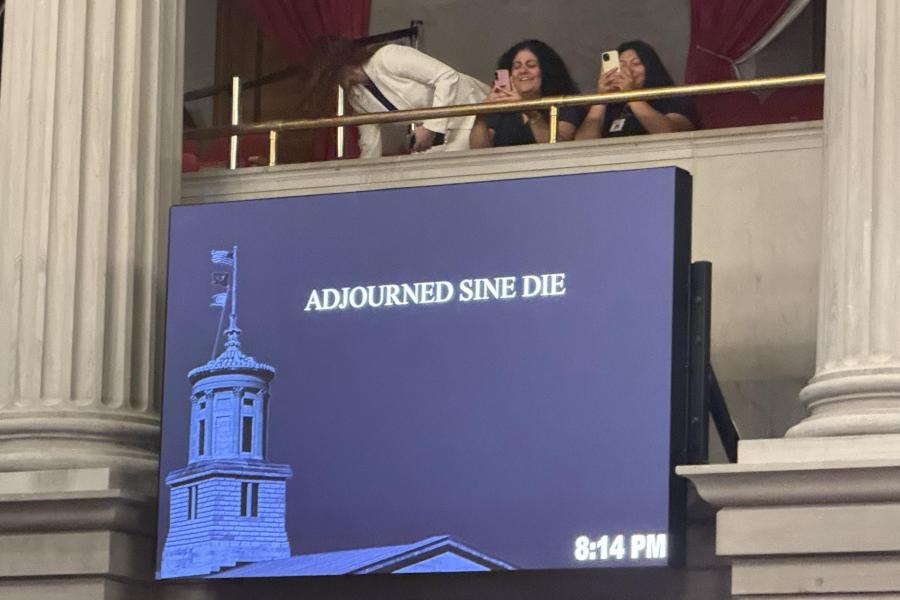
114th General Assembly adjourns sine die
By KATE COIL
TT&C Assistant Editor
The second session of the 114th Tennessee General Assembly adjourned Thursday, April 23, 2026, with lawmakers ultimately passing a $58.3 billion state budget.

The 2026-2027 Fiscal Year budget for Tennessee includes investments in healthcare, infrastructure, public safety, and education. The budget is slightly higher than $57.9 billion budget proposed by Gov. Bill Lee during his final State of the State address in February.
TML Executive Director Anthony Haynes thanked lawmakers for their considerations of the needs of municipalities and municipal officials across the state during the session.
“TML marks Sine Die with appreciation for the collaboration and dedication shown this session in advancing issues important to municipalities across Tennessee,” Haynes said. “We look forward to building on this progress and continuing to advocate for strong, vibrant communities statewide.”
SESSION SUCCESSES
Three key pieces of legislation that would have been detrimental to Tennessee’s towns and cities were defeated this session.

The Property Tax Cap(opens in a new tab) bill– also known as SB2064 (Watson) / HB1873 (Zachary) - would have artificially limited how much total property tax revenue can grow each year regardless of a community’s needs. While appealing on the surface, the bill would have severely limited the main and most consistent funding source nearly every city and county relies on for important services and infrastructure including police and fire departments, street repair, schools, and more. city and county relies on for important services and infrastructure including police and fire departments, street repair, schools, and more.
The Automatic Compensation for Land Use Decisions(opens in a new tab) bill – also known as the Tennessee Private Property Vesting Rights of 2026 Act and SB1908 (Stevens) / HB1837 (Hicks) - would have required automatic compensation for land‑use decisions.
The bill would have treated any claimed drop in property value because of a restriction as an automatic taking, guaranteeing compensation to the owner. This approach contradicts our current legal system, where courts look at each case individually based on constitutional law and established precedent. The bill also would have opened the door to constant lawsuits and made it difficult for cities to manage zoning and growth.
The bill to create Partisan Elections and Move City Elections(opens in a new tab) – also known as SB1630 (Hensley) / HB1497 (Cepicky) - would have made all local elections partisan and moved them to coincide with state and federal fall elections.

Concerns about this bill included the loss of essential local issues like public safety, streets, parks, and development in the noise of state and federal elections; the fact that voters chose local leaders on track records and community needs over party positions; and that partisan elections would change the tone of hometown elections, ultimately weakening the community-focused nature of local government.
Additionally, forcing every city and town to shift election dates would also break from long‑standing practice, conflict with recent state studies, and reduce local control.
Another major success was the passage of a TACIR study on public notices(opens in a new tab), or SB2450 (Powers) /HB2114 (Crawford). As most residents no longer receive news from print papers, requiring public notices in newspapers is expensive for taxpayers, slows down government work, and no longer meets the needs of citizenry where they are.
With the passage of the bill, the respected Tennessee Advisory Commission on Intergovernmental Relations (TACIR) will study whether printed newspapers are still the best outlet for governments to communicate public notices. The study will determine if online posting or other methods could provide clearer, faster, and more accessible transparency for the public.
BUDGET OVERVIEW
Of the $58.3 billion approved by state lawmakers, $30 billion comes from state general funds, $19 billion from federal funding, and the remainder is paid by fees, tuitions, and bonds. The FY 2026-2027 budget is a 9% decrease from the $59.8 billion budget passed for FY 2025-2026, according to House Finance, Ways and Means Committee Chairman Gary Hicks, R-Rogersville, who presented it to the House.
The budget projects the state to see 2.35% in revenue growth – approximately $450 million in recurring funds. Additionally, more than $620 million non-recurring funds were incorporated into the budget along with $42 million in unclaimed property revenues.
When the session reconvened in Nashville on Jan. 13, 2026, top priorities included Gov. Bill Lee’s Education Freedom Act, with 20,000 private school scholarships approved last year, immigration, infrastructure improvements and funding, artificial intelligence, and the state’s grocery tax.
Notably, lawmakers took $282.4 million from the Lee administration’s proposed budget and financed $276.4 million in legislative priorities. One of the biggest line items proposed for the budget by lawmakers is a $42 million non-recurring grant pool for emergency and community services.
The General Assembly ultimately funded Gov. Lee’s major economic opportunity proposals, including $20 million for the state’s Rain Day Fund, $8 million for the Tennessee Youth Employment Program, and $25 million for the Tennessee Entertainment Commission, along with many of the other goals set forward in the State of the State.
Several projects proposed in Gov. Lee’s budget received more funding that initially requested in the budget, including:
- $81.2 million for commercial and general aviation projects ($56.2 million initially proposed)
- $88.6 million to create three new state parks ($81.6 million proposed)
- $43 million for quantum computing industry expansion and investment ($20 million proposed)
Other requests received less funding than proposed, including
- $400 million for transportation infrastructure ($425 million proposed)
- $20 million to for a Starter Home Revolving Loan program ($30 million proposed)
- $15 million for the Rural Development Fund ($25 million proposed)
- $3.25 million for Corrections Education Investment ($3.5 million proposed)
- $44.2 million for the Governor’s Response and Recovery Fund ($100 million proposed)
- $50 million for Memphis public safety grants ($80 million proposed)
- $38.5 million for AI and government efficiency ($50 million proposed)
Some topics brought up at the beginning of the session, such as a proposed cut to the state’s 4% grocery tax, were not passed despite seeming to have some bipartisan support.
The FY 26-27 budget is the final under Gov. Bill Lee’s leadership.
“When I first became governor, I was hopeful about what we could accomplish in partnership with the General Assembly to serve Tennesseans,” said Gov. Lee. “Over eight legislative sessions, we’ve passed strategic measures to invest in education, strengthen our workforce, improve infrastructure, and secure our state’s position as a leader in next-generation nuclear energy. We’ve accomplished much together, and I’m deeply grateful to the members of the General Assembly who have worked alongside us to deliver real results for people across our state.”
Lt. Gov. Randy McNally, R-Oak Ridge, also reflected on the passage of the last budget of his tenure as he has decided to not seek re-election.
“This budget reflects the steady, fiscally responsible approach we’ve taken over the past decade,” McNally said. “We’ve kept spending under control while continuing to invest in those areas of paramount importance to our citizens, such as education, healthcare, and public safety. This discipline has resulted in structurally balanced budgets year after year, putting Tennessee in a strong position to provide for the people of Tennessee not just today, but in the years to come. I appreciate the work of each of our members to keep us on this path.”
House Speaker Cameron Sexton, R-Crossville, described the session as one of “the most consequential in Tennessee history.”
“We took bold action to crack down on crime and illegal immigration, strengthened enforcement, and protected our communities,” Sexton said. “We expanded education and healthcare freedom, breaking up monopolies and bringing real competition and choices for Tennesseans. Proud of the Tennessee House Republicans for keeping our state safe, strong, and leading the nation in conservative policy.”
SPECIAL SESSION
Gov. Lee recalled the Tennessee General Assembly for a special session on redistricting beginning May 5, 2026 and lasting until May 7, 2026. Lawmakers had until May 8, 2026 to redraw the map, which was the deadline for election commissions to prepare for the August federal primaries.
The new U.S. Congressional District map(opens in a new tab) for Tennessee was signed into law by Gov. Lee after passing the General Assembly. The Tennessee State House voted 64-25-3 to pass the bill with State Reps. Michele Reneau, R-Signal Mountain; Ron Travis, R-Dayton; and Greg Vital, R-Harrison; all voting “present but not voting.” The State Senate voted 25-5 in favor of the bill with State Sen. Richard Briggs, R-Knoxville, and Becky Massey, R-Knoxville, absent from the session.
FY 2026-27 Highlights |
|---|
|
Infrastructure & Housing |
|
Community Services & Emergency Report |
|
Healthcare & Public Safety |
|
Conservation |
|
Innovation |
|
President Donald Trump and U.S. Sen. Marsha Blackburn, R-Tennessee – who is also presently running for governor – both called for redistricting after the U.S. Supreme Court ruling in Louisiana v. Callais(opens in a new tab).
The 6-3 ruling held that a section of the Voting Rights Act that requires southern states to draw majority-minority U.S. House districts to ensure black voters are able to choose representatives was “an unconstitutional racial gerrymander.” In addition to Tennessee, Congressional Districts have been redrawn in California, Florida, Missouri, North Carolina, Ohio, Texas, and Utah. A voter referendum to redraw lines in Virginia has been struck down by a state court.
The special session was the fifth called by Gov. Bill Lee during his eight years as governor.