
Leveraging TNECD programs can transform communities
By KATE COIL
TT&C Assistant Editor
With vision and dedication, cities across Tennessee have realized long-term projects that have been transformational to their community for placemaking and economic development.

Tennessee Department of Economic and Community Development (TNECD) Assistant Commissioner of Rural and Community Development Brooxie Carlton discussed how different ECD programs have helped support different municipal projects with examples from Elizabethton Assistant City Manager Logan Engle, former McMinnville City Administrator Nolan Ming, and Paris City Manager Kim Foster.
Carlton said ECD has more than 30 different programs they offer with a large majority of grants going to local governments – though broadband providers, chambers of commerce, and economic development organizations can also benefit.
Most of ECD’s programs fall into one of three major categories: infrastructure, community development, and building partnerships. Infrastructure grants range from building new parks to water and wastewater improvements to broadband expansion, financing new emergency vehicles, and developing and identifying sites for future industrial use. Community development programs include downtown revitalizations, historical preservation, and placemaking grants.
“All of these projects today are about placemaking, about making your community a place people want to live and visit. Most of the towns that make up Tennessee are very small towns and these programs can have big impact.”
Carlton said ECD works with municipalities in a variety of ways to source funding, technical assistance, and other aid for a variety of projects.
“I love when people call me and say, ‘Here is what I want to do. How can I do it?’” Carlton said. “Knowing what your project it is makes it easier for us to help identify what steps need to be taken to get it done. It is a much easier way to develop a project than to see a grant is open and trying to come up with a project that will fit.”
GROWING MCMINNVILLE
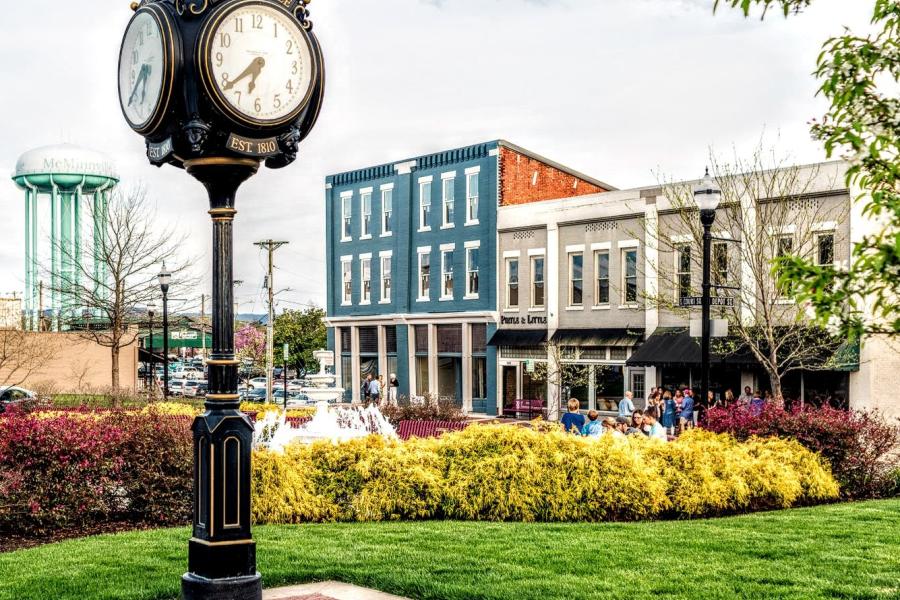
Located between major cities Nashville, Knoxville, and Chattanooga, former City Administrator Nolan Ming said McMinnville has a population of 14,000. It is known as the Nursey Capital of the World because hundreds of commercial nurseries are located there, providing millions of trees, shrubs, and flowers to lawn and garden centers, as well as landscaping companies across North America.

However, Ming said there were a few areas of the community that didn’t live up to the town’s overall reputation of beautification.
“We are a rural farm town that is heavily focused on grants to make things happen so we don’t have to raise taxes on our citizens,” he said. “If you have ever been to McMinnville, you know we have a beautiful downtown. We also have a beautiful river that is a bit further away from our downtown. Between the two, there are 100 acres of unused, post-industrial property. There is another area adjacent to a residential area in a different part of town that is about 30 acres of a former industrial site.”
Partnering with their local industrial development board, Ming said both properties were accepted by TNECD’s property evaluation program, and acceptance into that program helped show residents why the city was investing in these areas over others in the community.
"We have since acquired the Brownfield Redevelopment Area Grant (BRAG) through TDEC with $400,000 to do two phased assessments on the larger industrial parcel adjacent to downtown,” Ming said. “We also received just over $100,000 for the other property. When those assessments are done, the property owners are automatically enrolled in this voluntary assistance program through TDEC. They can then choose whether or not to remediate themselves. When that remediation is done, then we can secure grants to fund infrastructure proposed for each of those properties.”
The property adjacent to downtown is poised for commercial or retail expansion, which would almost triple the downtown retail district as well as connect it to the river. The second parcel is being developed into a children’s museum with a mixed-use retail and residential development being discussed.
“Ultimately, we have 130 acres of property added to our city without having to annex property,” Ming said. “This reactivates that unused property within our city limits to be useful for the community. There are a lot of different pieces and people to put together, but it’s been a good project so far.”
Ming said it is important to be ready for grants that come up, so incorporating those cycles into community and strategic planning is vital. Having clear goals, knowing what partners can help, and staying in communication with stakeholders are also vital.
REIMAGINING DOWNTOWN PARIS
While Paris is known for hosting the World’s Biggest Fish Fry and its Eiffel Tower Park, ity Manager Kim Foster said Paris has also become known for its downtown due to a coordinated, multi-year renovation effort.

“We have made tremendous strides in our downtown,” she said. “Several years, we were like most communities who had a downtown with empty storefronts. We struggled like everyone else did. We started on the path to revitalizing downtown with a city project. The alleys needed to be repaved, and our stormwater director suggested putting down pavers that could be easily removed because our water, sewer, utilities, cables, and everything like that is underground in those alleys. That way when something needs repair, you just remove the paver, do the work, and put it back.”
The pavers made the alleyways a more welcoming space, and the decision was made to see what else could be done to elevate the area.
“One of the grant programs we have been working with for more than 11 years now is Arts Build Communities, which the development districts administer,” Foster said. “They start off at around $4,000 with a 50-50 match. Over the last 11 years, we have added 35 individual paintings and pieces of art in the alleys and on buildings. There are a lot that focus on local history. One year, we shifted from on-the-wall projects to dumpsters. We had three big, green, ugly dumpsters downtown. We painted those dumpsters, which started a whole movement. We have businesses that come to us now wanting dumpsters to paint.”
In 2016, the city applied for the Facade Improvement Grant program from ECD. With $100,000 from the program, Foster said 13 businesses were able to replace windows, paint buildings, and make other improvements. Businesses had to provide a financial match to participate in the program.
Whileit took time and effort from city staff to reach out to local businesses, educate them, and gauge interest, Foster said the payoff on investment is great. Spending time and effort can get a lot done, even without a lot of money, she said.
“We have learned the best place to start is to get people involved, let them know they are part of the process, and you are doing this for them,” she said. “If you bring them in from the beginning, they tell you things you might not be aware of. They tell you little things that can make their life easier. If you go in and just start changing things, that can be earthshattering. Having those conversations first is important.”
After the first round, Foster said businesses owners who had not been part of the program also began improving their businesses to keep up. There was enough interest from local property and business owners that Paris applied again and received a second round of grants in 2021 with 49 applications for projects. A total of 17 have been funded, and Foster said Paris intends to apply for the upcoming round of the program.
Additionally, Foster said the Three Star Grant helped install speakers to play music in the downtown area while Historic Development Grants have helped several local businesses make improvements. “It’s all about quality of life, place, and community pride,” she said. “That’s what we’ve really created in our downtown. Our project is an ongoing project, and we had to change mindsets that this wasn’t something that was going to happen overnight; it is a lot of things over time.”
RENOVATING THE BONNIE KATE
Elizabethton Assistant City Manager Logan Engle said the city has seen similar return-on-investment from its downtown.
“Elizabethton is a city of almost 15,000, but I like to think we punch a little bit above our weight because we’re the county seat,” Engle said. “Our county has about 56,000 people, and everyone from the county comes to visit our downtown. We a lot of recreation assets in our community with two rivers that meet near downtown. Every time we put money into our downtown, it seems to spur more money and the growth of our downtown.”

One of the most successful downtown improvement projects Elizabethton has undertaken is the restoration of the Bonnie Kate Theater. Originally opened in 1926, the Bonnie Kate Theater was named for Bonnie Kate Sherrill Sevier, wife of Tennessee’s first Governor John Sevier. Originally showing silent films, the theater also hosted radio programs, theatrical performances, and war bond drives before closing in 2012.
“It had fallen into great disrepair, was privately held, and 10 years ago the city acquired the building, which was both good and bad,” Engle said. “Progress is sometimes painful. The first partnership that came out of that were community leaders who saw a need to save the Bonnie Kate in our historic downtown and advance the arts. The second partnership at the birth of this project was the East Tennessee Foundation. Private and public dollars helped the city acquire the building.”
The city purchased the theater in 2016 and, alongside the non-profit Friends of the Bonnie Kate, has worked to renovate the structure. The non-profit operates the theater through a lease agreement with the city.
“It has taken 10 years to get us where we are, and we are by no means finished,” Engle said. “These kinds of projects are incremental; they don’t happen overnight. They take time and investment, and we do a lot of other things in the city beyond these projects. We have to prioritize some things. The big piece beyond the city’s investment to spur this project further was the Appalachian Regional Commission (ARC) grant we received for renovations. We received the grant for it, and that meant we had to administer it. That began my involvement with the Bonnie Kate and working with our development district, our partners with TNECD, ARC, architects, and other groups.”
Engle said some of the major challenges for the project include the physical conversion of a space intended for a single purpose into a multi-purpose venue, as well as the clash between the creative vision and financial realities of the project.
One of the most recent updates to the project was the lighting of a new marquee over the theater, the fourth in the Bonnie Kate’s history. A grant from the Tennessee Arts Commission paid for the new marquee. A second, vertical component was funded through a Downtown Improvement Grant.
“We’ve leveraged a lot of different pots of money to get this far in the project,” she said. “Even though the theater reopened following a year of active construction, people still weren’t aware it was open. People often say to me, ‘Boy, I can’t wait for the Bonnie Kate to show movies again.’ They’ve been showing them a year. Now that the marquee is up, people really recognize it as a usable theater space. We probably had 150 people out in the street for the marquee lighting, and we had a 106-year-old lady light it who was alive when it was first opened and spent her childhood there.”
Engle said one major lesson she has taken from the project is how reaching out to other communities who have done similar projects can ease the path forward.
“If you are doing any kind of project, talk to your friends and neighbors, colleagues you meet at conferences, and people who have already walked the road you’ve been on,” she said. “They can tell you what to do and what not to do.”