

Tennessee looks to be on forefront as quantum technology changes AI
By KATE COIL
TT&C Assistant Editor
Through partnerships between Chattanooga Electric Power Board (EPB), Oak Ridge National Laboratory (ORNL), and the University of Tennessee at Chattanooga, Tennessee is positioning itself on the frontier of Quantum AI.

Quantum AI is the use of quantum computers and systems to run artificial intelligence (AI) systems more quickly with less cost and less energy. At present, AI is limited in its advancement and capabilities due to traditional computing resources, but many experts believe quantum technology could expand AI’s abilities.
Based on quantum bits or qubits, quantum technology enables computers to process millions of operations simultaneously. While quantum AI is still being researched and explored, Tennessee is working to be on the forefront of this groundbreaking technology.
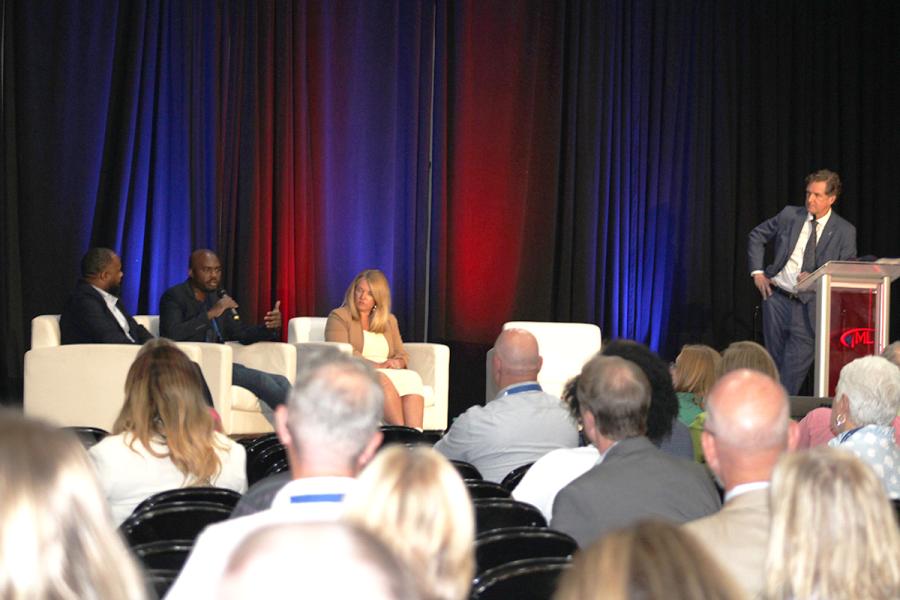
Chattanooga Mayor Tim Kelly hosted a forum at TML’s 85th Annual Conference in Chattanooga to discuss the future of AI and quantum computing featuring Evann Freeman, vice president of government and community relations at Chattanooga EPB; Jairobe McPherson, customer engineer with Google; and McKena McGraw, quantum information lead with Deloitte.
MUNICIPAL USE CASES
While quantum AI is already being explored for uses in healthcare and labor, McPherson said he thinks one of the ways the technology could be explored for municipal governments is with enterprise search, which takes different data sources from different organizations, consolidates them, and asks questions of that data.
“Traditionally, it has been very difficult for the organizations that hold this data together to actually get insights out,” he said. “When we look at some of the systems we have right now with AI, you can plug in different data sources. AI uses context windows, which is the amount of data you can pull in as context to any query you ask of an AI system. Those context windows are getting really large. You can throw questions into AI models and get insights in a lot easier manner.”

McPherson said he thinks another avenue for local governments is using conversational AI or virtual agents to engage with constituents and free up employee time. These AI programs can deliver information and resources faster than a human counterpart and with more specifics than a frequently-asked-questions page on a website. He also believes that AI can be used to deliver information to the public as well as break down sophisticated data into easy-to-understand facts, figures, and talking points.
Sometimes, simple use cases can be the most impactful. McPherson said the city of Chicago has developed an AI that interprets bus and rail routes and changes to those routes in a variety of languages. The result has been increased usership of those transit services as well as clearer communication when buses or routes have to change.
A county in Kentucky used AI in their strategic planning, allowing citizens to submit ideas and plans digitally and then have the AI sift through, categorize, and prioritize these ideas into a generated report with action items for county officials. This also allowed city officials to separate the ideas that had the most support from those that were just being shared by the loudest voices.
“However big or small your city or agency is, there are likely applications for AI use cases that can help you really achieve the aims you are looking for,” McPherson said.
However, McGraw said AI alone cannot be the answer for everything.
“There are some things that AI on a classical computer can never learn,” she said. “With quantum, we can access a new space and think about generalizing our AI capabilities to solve very hard problems. AI can’t solve a physics or science problem, and it never will. With quantum and the computational power it can allow for, we can take AI to the next level.”
QUANTUM TRANSITION
McGraw said quantum fundamentally changes the way we think about information.

“We are actually able to use properties of atoms and molecules to do useful things,” she said. “Quantum information is very different than what is on your phones or your laptop. Quantum allows us to access a new scale and solve programs on a bigger scale than even the fastest super computers at ORNL can do. It’s a challenge that has been put on by Google and IBM to beat those machines at ORNL on much smaller machines using quantum information.”
Quantum can make processes more efficient, which renders more accurate solutions more quickly. It also provides a new type of security.
“The idea is that as we move into quantum information, we can use quantum cryptography on quantum networks and quantum computers,” McGraw said. “For instance, through something known as blind computing, no one would be able to know what you were doing on your phone or who you were talking to based on properties of quantum physics.”
Freeman said part of Chattanooga EPB’s mission is to enhance quality of life, which is why the utility began working on municipal broadband. The utility has also partnered with ORNL to improve electric service and output for Chattanooga and EPB’s wider service area through the use of microgrids and other future energy technology.
“One of the things that came up in 2006 was the Department of Energy (DOE) called us about working with San Francisco-based Qubitekk to use quantum to secure our substations,” Freeman said. “It was successful, and we continued to do tests with them.”
The success of this project prompted Chattanooga EPB, the city of Chattanooga, and Qubitekk to build a quantum network in Chattanooga. The network allows private companies, government agencies, national labs, and universities to explore what quantum computing can do for them, as well as test and upgrade their security.
“The idea is similar to us building our broadband service for our community,” Freeman said. “We built the infrastructure and didn’t know how it would turn out. We didn’t expect more than 9,000 jobs to be created or $2.7 billion in economic impact and lots of companies locating here in our community. We are building this infrastructure because we believe in this infrastructure and that it can do big things.”
ETHICAL CONSIDERATIONS
There are always ethical issues to consider with implementing any AI system or new technology. As AI technology evolves, so do the ways that bad actors seek to exploit that data.

“It is a lot easier to get data into some of these AI systems than it is to get it out,” McPherson said. “Any data you put into an AI system can be used for training. You have to really think about the privacy of the data you are inputting. For hyperscale models like those provided by Google or Microsoft, you are going to have to hand over some data to them. It is important that you have a technology partner that has the tools and safety in place to make sure data is kept private and secure.”
There is also concern that human biases can be entered into AI systems, making their output biased as well.
“These AI are trained on data by humans, and as human beings, we are, by nature, biased creatures,” McPherson said. “The best thing you can do as a local government agency leveraging this technology is to be aware of that bias. You can sometimes use some of these same tools that have bias in them to eliminate that bias. You have to implement things to mitigate and resolve those risks and gaps.”

McGraw said being able to explain results generated by technology is another ethical concern.
“You give AI a bunch of data, but you don’t know what it is learning from that data before it spits out an answer,” McGraw said. “There are instances where that is not OK. The ability to explain an outcome of a machinery or algorithm is very important. I can’t go to a customer and tell them I think they’re involved with human trafficking without telling them way. This is where you need something that is explainable.”
With data centers opening in communities across the country, there is concern that Big Data is overloading the electric grid at the expense of local power users. Freeman said quantum can be used to optimize electric grids that require more output for data centers.
Presently, McGraw said the use of AI requires more data centers, and bigger data centers are needed for AI to solve bigger problems. Incorporating quantum technology into the equation may provide a solution. “This is kind of an open problem we are figuring out,” McGraw said. “The idea behind it is that these quantum computers can get to a solution exponentially faster than a classical computer with a lot smaller infrastructure. As quantum computers become more commercially available, instead of huge data centers across Arizona, Nevada, and New Mexico hidden in the mountains powering AI, we would be able to do so with much smaller facilities and much more accuracy. Of course, it is still speculative in what we are able to do.”