

State Data Center: Tennessee has nation's eighth largest population increase in 2025
Tennessee State Data Center
Tennessee’s population increase was the nation’s 8th largest last year – adding nearly 64,000 new residents and reaching a population of 7.32 million people.
New population estimates released by the U.S. Census Bureau last week(opens in a new tab) show Tennessee was again listed among the country’s fastest-growing states. The state added 68,785 new residents between July 1, 2024, and July 1, 2025 – a 0.88% one-year increase.
That pushed Tennessee’s population to a mark of 7,315,076 people on July 1, 2025.
Net domestic migration, the difference between inbound and outbound movers to and from other states, was the main contributor to Tennessee’s population gains. It resulted in the addition of 42,389 people – the fourth highest in the country behind the Carolinas and Texas.
But it was also the third straight year that this component slipped from the state’s record high in 2022. That was part of a broader slowing of domestic migration in Tennessee and its bordering states. Only Tennessee and Alabama saw decreases compared to last year’s levels.
International migration added almost 18,000 new residents to Tennessee’s population in 2025. This was a sizeable 30,000-person drop compared to the 2024 level, which grew to nearly 48,000 people – a one-year high. A new method for determining the state and county where humanitarian migrants settled(opens in a new tab) in the U.S. was behind the significant upward revision of the net international migration figures that were published in December 2024. That new data showed that net international migration outpaced domestic migration in 2024.
Every state in the country(opens in a new tab) saw lower levels of international migration in 2025, and further slowing is expected in 2026. While the component is still projected to remain net positive(opens in a new tab) at the national level next year, declining rates of immigration and accelerated emigration could see some states tipping into negative territory. That hasn’t happened to a measurable degree since 2003(opens in a new tab) when six states had single-year, net negative numbers.
The South Region of the U.S., which stretches from Delaware and Florida in the east to Texas and Oklahoma in the west, was once again the nation’s fastest-growing region, with a 0.9% population increase in 2025. That was down from gains of 1.3 to 1.4% between 2022 and 2024. The south’s decelerating growth rate last year was part of a larger national trend that saw population change slow in all four regions of the country(opens in a new tab) and all but 2 states. The historic declines in net international migration were clearly a factor in last year’s drop.
The immigration-related policy shift brings domestic migration back into focus as the predominant component of population change(opens in a new tab) for Tennessee and many other states.
On that front, it is also clear that the South Region of the U.S. got off to a hot start in the 2020’s. The region has pulled residents from other parts of the country at a 50% higher clip than it did during the last decade’s sluggish start in the wake of the Great Recession. And through 2025, the south region has been the only part of the country to maintain positive levels of net domestic migration this decade, except for a Midwest region rebound in 2025(opens in a new tab).
But a trend of slowing migration to the South is becoming evident. Following a sharp drop in 2024, the South Region of the U.S. sank to its lowest level of domestic migration in 2025, gaining 357,800 people. That was the smallest increase that the region has seen from this component since 2018.
Tennessee is among the group of states that have seen net domestic migration cool over the past three years, but it’s the region’s two most populous states that account for a large portion of that decrease. Florida’s domestic migration is down 93% from its national-high net gain of 310,892 people in 2022, adding just 22,517 people from this component in 2025. Texas’s levels of net domestic migration have slowed 69%. Alabama, Arkansas, Georgia, Kentucky, North Carolina, Oklahoma and South Carolina have also experienced slowdowns since 2022.
Tennessee was the 10th fastest-growing state on a percentage basis in 2025, and its population gain ranked as the 8th largest. The state has consistently hovered around these marks throughout the 2020s – a decade which has featured unusual levels of population volatility.
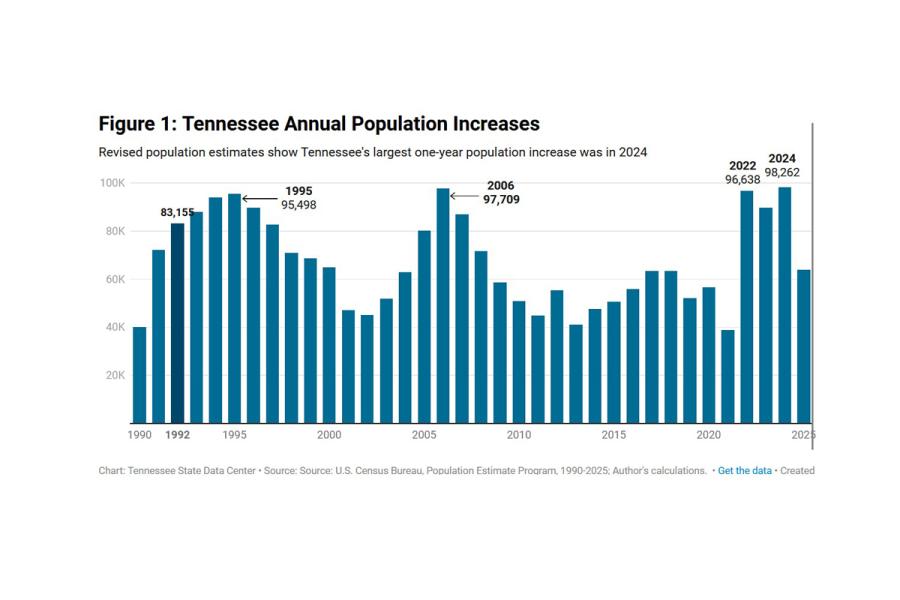
The decade began with a marked increase in deaths from the COVID-19 pandemic that led to the state’s first natural decreases. This was followed by record numbers of inbound movers from other states in 2022 and a separate surge in international migration that peaked in 2024. In fact, the Bureau’s revised population estimate figures show that Tennessee’s 98,262-person increase in 2024 was the largest in the state’s history.
Through the first half of the decade, Tennessee has added nearly 402,000 new residents. That is only surpassed by the period from 1990 to 1995 when the state added 450,000 new residents at the start of the most expansive decade in the state’s history.
The Volunteer State has experienced record highs and lows this decade, but through those extremes has managed to maintain a top position among the states adding the most population.